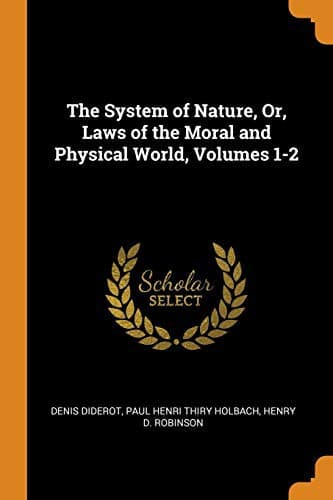
The System of Nature, or, the Laws of the Moral and Physical World. Volume 1Holbach, Paul Henri Thiry, baron d'
Religion
The System of Nature, or, the Laws of the Moral and Physical World. Volume 1
Holbach, Paul Henri Thiry, baron d'
Materialism; Philosophy and religion; Psychology
The right of man over his fellow man can only be founded either upon the
actual happiness he secures to him, or that which he gives him reason to
hope he will procure for him; without this, the power he exercises would
be violence, usurpation, manifest tyranny; it is only upon the faculty
of rendering him happy, that legitimate authority builds its structure;
without this it is the "_baseless fabric of a vision." No man derives
from nature the right of commanding another_; but it is voluntarily
accorded to those, from whom he expects his welfare. _Government_ is the
right of commanding, conferred on the sovereign only for the advantage
of those who are governed. Sovereigns are the defenders of the persons,
the guardians of the property, the protectors of the liberty of their
subjects: this is the price of their obedience; it is only on this
condition these consent to obey; government would not be better than
a robbery whenever it availed itself of the powers confided to it,
to render society unhappy. _The empire of religion_ is founded on the
opinion man entertains of its having power to render nations happy;
government and religion are reasonable institutions; but only so,
inasmuch as they equally contribute to the felicity of man: it would
be folly in him to submit himself to a yoke from which there resulted
nothing but evil. It would be folly to expect that man should bind
himself to misery; it would be rank injustice to oblige him to renounce
his rights without some corresponding advantage!
The authority which a father exercises over his family is only founded
on the advantages which he is supposed to procure for it. Rank, in
political society, has only for its basis the real or imaginary utility
of some citizens for which the others are willing to distinguish
them--agree to respect them--consent to obey them. The rich acquire
rights over the indigent, the wealthy claim the homage of the needy,
only by virtue of the welfare they are conditioned to procure
them. Genius, talents, science, arts, have rights over man, only
in consequence of their utility; of the delight they confer; of the
advantages they procure for society. In a word, it is happiness, it is
the expectation of happiness, it is its image that man cherishes--that
he esteems--that he unceasingly adores. Monarchs, the rich, the great,
may easily impose on him, may dazzle him, may intimidate him, but they
will never be able to obtain the voluntary submission of his heart,
which alone can confer upon them legitimate rights, without they make
him experience real benefits--without they display virtue. Utility is
nothing more than true happiness; to be useful is to be virtuous; to be
virtuous is to make others happy.
Public-domain text, read in full here on John Shaqi.
Reviews
Reviews
No reviews yet
Be the first to share your thoughts on this work.
Elsewhere in the archive
Join the Discussion
Join the discussion
Sign in to leave a comment or review.
Sign InorCreate an account