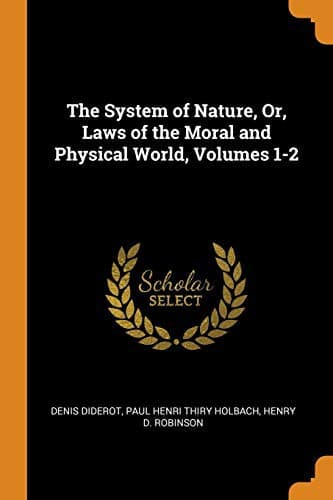
The System of Nature, or, the Laws of the Moral and Physical World. Volume 1Holbach, Paul Henri Thiry, baron d'
Religion
The System of Nature, or, the Laws of the Moral and Physical World. Volume 1
Holbach, Paul Henri Thiry, baron d'
Materialism; Philosophy and religion; Psychology
As long as man desires the continuation of his being, he has no right
to call himself completely unhappy; whilst hope sustains him, he still
enjoys a great benefit. If man was more just, in rendering to himself an
account of his pleasures, in estimating his pains, he would acknowledge
that the sum of the first exceeds by much the amount of the last; he
would perceive that he keeps a very exact ledger of the evil, but a very
unfaithful journal of the good: indeed he would avow, that there are but
few days entirely unhappy during the whole course of his existence. His
periodical wants procure for him the pleasure of satisfying them; his
soul is perpetually moved by a thousand objects, of which, the variety,
the multiplicity, the novelty, rejoices him, suspends his sorrows,
diverts his chagrin. His physical evils, are they violent? They are not
of long duration; they conduct him quickly to his end: the sorrows of
his mind, when too powerful, conduct him to it equally. At the same time
nature refuses him every happiness, she opens to him a door by which he
quits life; does he refuse to enter it? It is that he yet finds pleasure
in existence. Are nations reduced to despair? Are they completely
miserable? They have recourse to arms; at the risque of perishing, they
make the most violent efforts to terminate there sufferings.
Thus because he sees so many of his fellows cling to life, man ought
to conclude they are not so unhappy as he thinks. Then let him not
exaggerate the evils of the human race, but let him impose silence on
that gloomy humour that persuades him these evils are without remedy;
let him only diminish by degrees the number of his errors, his
calamities will vanish in the same proportion; he is not to conclude
himself infelicitous because his heart never ceases to form new desires,
which he finds it difficult, sometimes impossible to gratify. Since his
body daily requires nourishment, let him infer that it is sound, that it
fulfils its functions. As long as he has desires, the proper deduction
ought to be, that his mind is kept in the necessary activity; he should
gather from all this that passions are essential to him, that they
constitute the happiness of a being who feels; are indispensable to a
man who thinks; are requisite to furnish him with ideas; that they are
a vital principle with a creature who must necessarily love that which
procures him comfort, who must equally desire that which promises him
a mode of existence analogous to his natural energies. As long as he
exists, as long as the spring of his soul maintains its elasticity, this
soul desires; as long as it desires, he experiences the activity which
is necessary to him; as long as he acts, so long he lives. Human life
may be compared to a river, of which the waters succeed each other,
drive each other forward, and flow on without interruption; these
waters, obliged to roll over an unequal bed, encounter at intervals
Public-domain text, read in full here on John Shaqi.
Reviews
Reviews
No reviews yet
Be the first to share your thoughts on this work.
Elsewhere in the archive
Join the Discussion
Join the discussion
Sign in to leave a comment or review.
Sign InorCreate an account