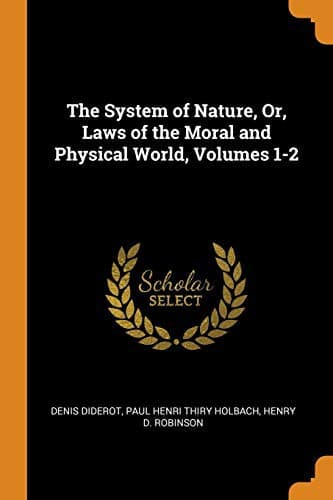
The System of Nature, or, the Laws of the Moral and Physical World. Volume 1Holbach, Paul Henri Thiry, baron d'
Religion
The System of Nature, or, the Laws of the Moral and Physical World. Volume 1
Holbach, Paul Henri Thiry, baron d'
Materialism; Philosophy and religion; Psychology
Man is frequently so wicked, only, because he almost always feels
himself interested in being so; let him be more enlightened, more
familiarized with truth, more accustomed to virtue, he will be made more
happy; he will necessarily become better. An equitable government,
a vigilant administration, will presently fill the state with honest
citizens; it will hold forth to them present reasons for benevolence;
real advantages in truth; palpable motives to be virtuous; it will
instruct them in their duties; it will foster them with its cares; it
will allure them by the assurance of their own peculiar happiness; its
promises faithfully fulfilled--its menaces regularly executed,
will unquestionably have much more weight than those of a gloomy
superstition, which never exhibits to their view other than illusory
benefits, fallacious punishments, which the man hardened in wickedness
will doubt every time he finds an interest in questioning them: present
motives will tell more home to his heart than those which are distant
and at best uncertain. The vicious and the wicked are so common upon
the earth, so pertinacious in their evil courses, so attached to their
irregularities, only because there are but few governments that make
man feel the advantage of being just, the pleasure of being honest, the
happiness of being benevolent on the contrary, there is hardly any
place where the most powerful interests do not solicit him to crime, by
favouring the propensities of a vicious organization; by countenancing
those appetencies which nothing has attempted to rectify or lead
towards virtue. A savage, who in his horde knows not the value of money,
certainly would not commit a crime, if when transplanted into civilized
society, he should presently learn to desire it, should make efforts to
obtain it, and if he could without danger finish by stealing it; above
all, if he had not been taught to respect the property of the beings who
environ him. The savages and the child are precisely in the same
state; it is the negligence of society, of those entrusted with their
education, that renders both the one and the other wicked. The son of
a noble, from his infancy learns to desire power, at a riper age he
becomes ambitious; if he has the address to insinuate himself into
favor, he perhaps becomes wicked, because in some societies he has been
taught to know he may be so with impunity when he can command the ear
of his sovereign. It is not therefore nature that makes man wicked, they
are his institutions which determine him to vice. The infant brought up
amongst robbers, can generally become nothing but a malefactor; if he
had been reared with honest people, the chance is he would have been a
virtuous man.
Public-domain text, read in full here on John Shaqi.
Reviews
Reviews
No reviews yet
Be the first to share your thoughts on this work.
Elsewhere in the archive
Join the Discussion
Join the discussion
Sign in to leave a comment or review.
Sign InorCreate an account