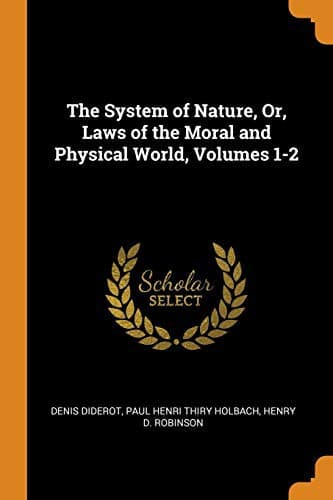
The System of Nature, or, the Laws of the Moral and Physical World. Volume 1Holbach, Paul Henri Thiry, baron d'
Religion
The System of Nature, or, the Laws of the Moral and Physical World. Volume 1
Holbach, Paul Henri Thiry, baron d'
Materialism; Philosophy and religion; Psychology
If the source be traced of that profound ignorance in which man is with
respect to his morals, to the motives that can give volition to his
will, it will be found in those false ideas which the greater number of
speculators have formed to themselves, of human nature. The science of
morals has become an enigma which it is impossible to unrevel; because
man has made himself double; has distinguished his soul from his body;
supposed it of a nature different from all known beings, with modes of
action, with properties distinct from all other bodies, because he
has emancipated this soul from physical laws, in order to submit it to
capricious laws emanating from men who have pretended they are derived
from imaginary regions, placed at very remote distances: metaphysicians
seized upon these gratuitous suppositions, and by dint of subtilizing
them, have rendered them completely unintelligible. These moralists have
not perceived that motion is essential to the soul as well as to the
living body; that both the one and the other are never moved but
by material, by physical objects; that the want of each regenerate
themselves unceasingly; that the wants of the soul, as well as those of
the body are purely physical; that the most intimate, the most constant
connection subsists between the soul and the body; or rather they have
been unwilling to allow that they ate only the same thing considered
under different points of view. Obstinate in their supernatural,
unintelligible opinions, they have refused to open their eyes, which
would have convinced them that the body in suffering rendered the soul
miserable; that the soul afflicted undermined the body and brought it to
decay; that both the pleasures and agonies of the mind have an influence
over the body, either plunge it into sloth or give it activity: they
have rather chosen to believe, that the soul draws its thoughts, whether
pleasant or gloomy, from its own peculiar sources, while the fact is,
that it derives its ideas only from material objects that strike on the
physical organs; that it is neither determined to gaiety nor led on to
sorrow, but by the actual state, whether permanent or transitory, in
which the fluids and solids of the body are found. In short, they have
been loath to acknowledge that the soul, purely passive, undergoes
the same changes which the body experiences; is only moved by its
intervention; acts only by its assistance, receives its sensations, its
perceptions, forms its ideas, derives either its happiness or its misery
from physical objects, through the medium of the organs of which the
body is composed; frequently without its own cognizance, often in
despite of itself.
Public-domain text, read in full here on John Shaqi.
Reviews
Reviews
No reviews yet
Be the first to share your thoughts on this work.
Elsewhere in the archive
Join the Discussion
Join the discussion
Sign in to leave a comment or review.
Sign InorCreate an account