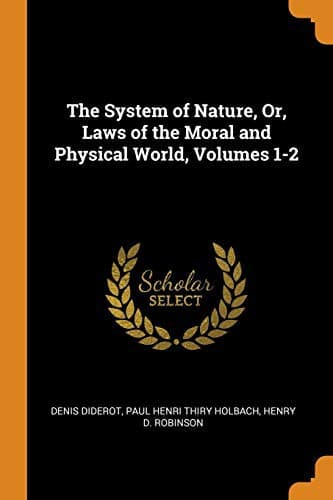
The System of Nature, or, the Laws of the Moral and Physical World. Volume 1Holbach, Paul Henri Thiry, baron d'
Religion
The System of Nature, or, the Laws of the Moral and Physical World. Volume 1
Holbach, Paul Henri Thiry, baron d'
Materialism; Philosophy and religion; Psychology
From every thing which has been hitherto said, it evidently results that
all the errors of mankind, of whatever nature they may be, arise from
man's having renounced reason, quitted experience, and refused
the evidence of his senses that he might be guided by imagination,
frequently deceitful; by authority, always suspicious. Man will ever
mistake his true happiness as long as he neglects to study nature, to
investigate her laws, to seek in her alone the remedies for those
evils which are the consequence of his errors: he will be an enigma to
himself, as long as he shall believe himself double; that he is moved by
an inconceivable spiritual power, of the laws and nature of which he is
ignorant; his intellectual, as well as his moral faculties, will remain
unintelligible to him if he does not contemplate them with the same
eyes as he does his corporeal qualities; if he does not view them as
submitted in every thing to the same impulse, as governed by the same
regulations. The system of his pretended free agency is without support;
experience contradicts it every instant, and proves that he never ceases
to be under the influence of necessity in all his actions; this truth,
far from being dangerous to man, far from being destructive of his
morals, furnishes him with their true basis by making him feel the
necessity of those relations which subsists between sensible beings
united in society: who have congregated with a view of uniting their
common efforts for their reciprocal felicity. From the necessity of
these relations, spring the necessity of his duties; these point out to
him the sentiments of love, which he should accord to virtuous conduct;
that aversion he should have for what is vicious; the horror he should
feel for every thing criminal. From hence the true foundation of _Moral
Obligation_ will be obvious, which is only the necessity of talking
means to obtain the end man proposes to himself by uniting in society;
in which each individual for his own peculiar interest, his own
particular happiness, his own personal security, is obliged to display
dispositions requisite to conciliate the affections of his associates;
to hold a conduct suitable to the preservation of the community; to
contribute by his actions to the happiness of the whole. In a word, it
is upon the necessary action and re-action of the human will upon the
necessary attraction and repulsion of man's soul, that all his morals
are bottomed: it is the unison of his will, the concert of his actions,
that maintains society; it is rendered miserable by his discordance; it
is dissolved by his want of union.
Public-domain text, read in full here on John Shaqi.
Reviews
Reviews
No reviews yet
Be the first to share your thoughts on this work.
Elsewhere in the archive
Join the Discussion
Join the discussion
Sign in to leave a comment or review.
Sign InorCreate an account