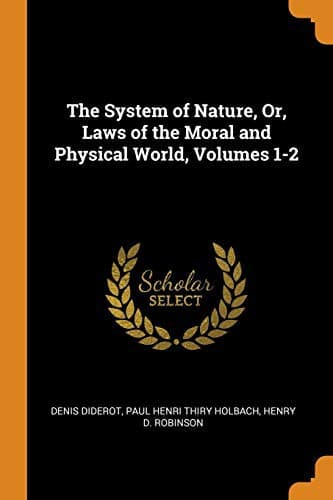
The System of Nature, or, the Laws of the Moral and Physical World. Volume 1Holbach, Paul Henri Thiry, baron d'
Religion
The System of Nature, or, the Laws of the Moral and Physical World. Volume 1
Holbach, Paul Henri Thiry, baron d'
Materialism; Philosophy and religion; Psychology
Be this as it may, whenever we see a cause act, we look upon its effect
as natural: when this cause becomes familiar to the sight, when we are
accustomed to it, we think we understand it, and its effects surprise
us no longer. Whenever any unusual effect is perceived, without our
discovering the cause, the mind sets to work, becomes uneasy; this
uneasiness increases in proportion to its extent: as soon as it is
believed to threaten our preservation, we become completely agitated; we
seek after the cause with an earnestness proportioned to our alarm;
our perplexity augments in a ratio equivalent to the persuasion we are
under: how essentially requisite it is, we should become acquainted with
the cause that has affected us in so lively a manner. As it frequently
happens that our senses can teach us nothing respecting this cause
which so deeply interests us--which we seek with so much ardour, we have
recourse to our imagination; this, disturbed with alarm, enervated by
fear, becomes a suspicious, a fallacious guide: we create chimeras,
fictitious causes, to whom we give the credit, to whom we ascribe the
honour of those phenomena by which we have been so much alarmed. It is
to this disposition of the human mind that must be attributed, as will
be seen in the sequel, the religious errors of man, who, despairing of
the capacity to trace the natural causes of those perplexing phenomena
to which he was the witness, and sometimes the victim, created in his
brain (heated with terror) imaginary causes, which have become to him a
source of the most extravagant folly.
In Nature, however, there can be only natural causes and effects; all
motion excited in this Nature, follows constant and necessary laws: the
natural operations, to the knowledge of which we are competent, of which
we are in a capacity to judge, are of themselves sufficient to enable us
to discover those which elude our sight; we can at least judge of them
by analogy. If we study Nature with attention, the modes of action which
she displays to our senses will teach us not to be disconcerted by those
which she refuses to discover. Those causes which are the most remote
from their effects, unquestionably act by intermediate causes; by the
aid of these, we can frequently trace out the first. If in the chain of
these causes we sometimes meet with obstacles that oppose themselves
to our research, we ought to endeavour by patience and diligence to
overcome them; when it so happens we cannot surmount the difficulties
that occur, we still are never justified in concluding the chain to be
broken, or that the cause which acts is SUPER-NATURAL. Let us, then, be
content with an honest avowal, that Nature contains resources of which
we are ignorant; but never let us substitute phantoms, fictions, or
imaginary causes, senseless terms, for those causes which escape our
research; because, by such means we only confirm ourselves in ignorance,
impede our enquiries, and obstinately remain in error.
Public-domain text, read in full here on John Shaqi.
Reviews
Reviews
No reviews yet
Be the first to share your thoughts on this work.
Join the Discussion
Join the discussion
Sign in to leave a comment or review.
Sign InorCreate an account