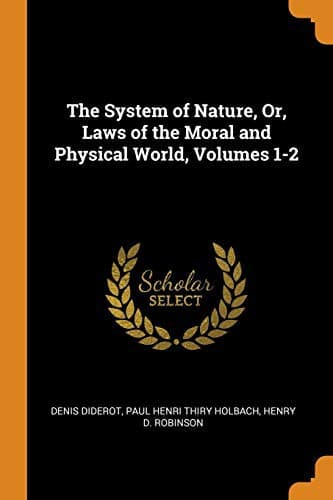
The System of Nature, or, the Laws of the Moral and Physical World. Volume 1Holbach, Paul Henri Thiry, baron d'
Religion
The System of Nature, or, the Laws of the Moral and Physical World. Volume 1
Holbach, Paul Henri Thiry, baron d'
Materialism; Philosophy and religion; Psychology
Of whatever nature may be the combination of beings, their motion has
always one direction or tendency: without direction we could not have
any idea of motion: this direction is regulated by the properties of
each being; as soon as they have any given properties, they necessarily
act in obedience to them: that is to say, they follow the law invariably
determined by these same properties; which, of themselves, constitute
the being such as he is found, and settle his mode of action, which
is always the consequence of his manner of existence. But what is the
general direction, or common tendency, we see in all beings? What is
the visible and known end of all their motion? It is to conserve their
actual existence--to preserve themselves--to strengthen their several
bodies--to attract that which is favorable to them--to repel that
which is injurious them--to avoid that which can harm them--to resist
impulsions contrary to their manner of existence, and to their natural
tendency.
To exist, is to experience the motion peculiar to a determinate essence:
to conserve this existence, is to give and receive that motion from
which results its maintenance:--it is to attract matter suitable
to corroborate its being--to avoid that by which it may be either
endangered or enfeebled. Thus, all beings of which we have any
knowledge, have a tendency to conserve themselves, each after its
peculiar manner: the stone, by the firm adhesion of its particles,
opposes resistance to its destruction. Organized beings conserve
themselves by more complicated means, but which are, nevertheless,
calculated to maintain their existence against that by which it may
be injured. Man, both in his physical and in his moral capacity, is
a living, feeling, thinking, active being; who, every instant of his
duration, strives equally to avoid that which may be injurious, and to
procure that which is pleasing to him, or that which is suitable to his
mode of existence; all his actions tending solely to conserve himself.
ST. AUGUSTINE admits this tendency in all whether organized or not.
Public-domain text, read in full here on John Shaqi.
Reviews
Reviews
No reviews yet
Be the first to share your thoughts on this work.
Join the Discussion
Join the discussion
Sign in to leave a comment or review.
Sign InorCreate an account