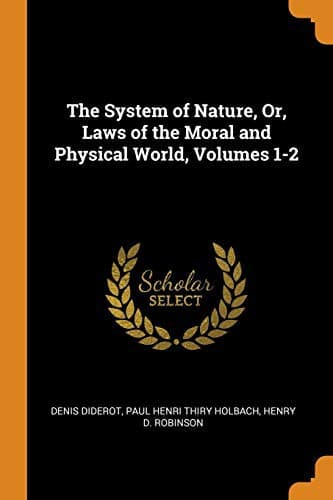
The System of Nature, or, the Laws of the Moral and Physical World. Volume 1Holbach, Paul Henri Thiry, baron d'
Religion
The System of Nature, or, the Laws of the Moral and Physical World. Volume 1
Holbach, Paul Henri Thiry, baron d'
Materialism; Philosophy and religion; Psychology
Necessity is the constant and infallible relation of causes with their
effects. Fire consumes, of necessity, combustible matter plated within
its circuit of action: man, by fatality, desires either that which
really is, or appears to be serviceable to his welfare. Nature, in all
the extraordinary appearances she exhibits, necessarily acts after her
own peculiar essence: all the beings she contains, necessarily act each
after its own a individual nature: it is by motion that the whole has
relation with its parts; and these parts with the whole: it is thus
that in the general system every thing is connected: it is itself but
an immense chain of causes and effects, which flow without ceasing, one
from the other. If we reflect, we shall be obliged to acknowledge that
every thing we see is necessary; that it cannot be otherwise than it is;
that all the beings we behold, as well as those which escape our
sight, act by invariable laws. According to these laws, heavy
bodies fall--light bodies ascend--analogous substances attract each
other--beings tend to preserve themselves--man cherishes himself; loves
that which he thinks advantageous--detests that which he has an idea may
prove unfavourable to him.--In fine, we are obliged to admit, there
can be no perfectly independent energy--no separated cause--no detached
action, in a nature where all the beings are in a reciprocity of
action--who, without interruption, mutually impel and resist each
other--who is herself nothing more than an eternal circle of motion,
given and received according to necessary laws; which under the same
given incidents, invariably produce the same effect.
Two examples will serve to throw the principle here laid down, into
light--one shall be taken from physics, the other from morals.
In a whirlwind of dust, raised by elemental force, confused as it
appears to our eyes, in the most frightful tempest excited by contrary
winds, when the waves roll high as mountains, there is not a single
particle of dust, or drop of water, that has been placed by CHANCE, that
has not a cause for occupying the place where it is found; that does
not, in the most rigorous sense of the word, act after the manner in
which it ought to act; that is, according to its own peculiar essence,
and that of the beings from whom it receives this communicated force.
A geometrician exactly knew the different energies acting in each case,
with the properties of the particles moved, could demonstrate that after
the causes given, each particle acted precisely as it ought to act, and
that it could not have acted otherwise than it did.
Public-domain text, read in full here on John Shaqi.
Reviews
Reviews
No reviews yet
Be the first to share your thoughts on this work.
Join the Discussion
Join the discussion
Sign in to leave a comment or review.
Sign InorCreate an account