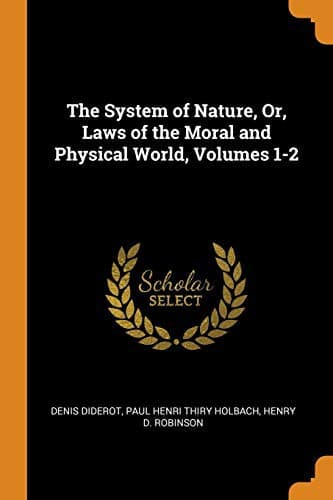
The System of Nature, or, the Laws of the Moral and Physical World. Volume 1Holbach, Paul Henri Thiry, baron d'
Religion
The System of Nature, or, the Laws of the Moral and Physical World. Volume 1
Holbach, Paul Henri Thiry, baron d'
Materialism; Philosophy and religion; Psychology
We say, he is a material being, organized after a peculiar manner;
conformed to a certain mode of thinking--of feeling; capable
of modification in certain modes peculiar to himself--to his
organization--to that particular combination of matter which is found
assembled in him.
If, again, it be asked, what origin we give to beings of the human
species?
We reply, that, like all other beings, man is a production of Nature,
who resembles them in some respects, and finds himself submitted to
the same laws; who differs from them in other respects, and follows
particular laws, determined by the diversity of his conformation.
If, then, it be demanded, whence came man?
We answer, our experience on this head does not capacitate us to resolve
the question: but that it cannot interest us, as it suffices for us to
know that man exists; that he is so constituted, as to be competent to
the effects we witness.
But it will be urged, has man always existed? Has the human species
existed from all eternity; or is it only an instantaneous production of
Nature? Have there been always men like ourselves? Will there always
be such? Have there been, in all times, males and females? Was there a
first man, from whom all others are descended? Was the animal anterior
to the egg, or did the egg precede the animal? Is this species without
beginning? Will it also be without end? The species itself, is it
indestructible, or does it pass away like its individuals? Has man
always been what he now is; or has he, before he arrived at the state in
which we see him, been obliged to pass under an infinity of successive
developements? Can man at last flatter himself with having arrived at
a fixed being, or must the human species again change? If man is the
production of Nature, it will perhaps be asked, Is this Nature competent
to the production of new beings, to make the old species disappear?
Adopting this supposition, it may be inquired, why Nature does not
produce under our own eyes new beings--new species?
It would appear on reviewing these questions, to be perfectly
indifferent, as to the stability of the argument we have used, which
side was taken; that, for want of experience, hypothesis must settle a
curiosity that always endeavours to spring forward beyond the boundaries
prescribed to our mind. This granted, the contemplator of Nature will
say, that he sees no contradiction, in supposing the human species, such
as it is at the present day, was either produced in the course of time,
or from all eternity: he will not perceive any advantage that can arise
from supposing that it has arrived by different stages, or successive
developements, to that state in which it is actually found. Matter is
eternal, it is necessary, but its forms are evanescent and contingent.
It may be asked of man, is he any thing more than matter combined, of
which the former varies every instant?
Public-domain text, read in full here on John Shaqi.
Reviews
Reviews
No reviews yet
Be the first to share your thoughts on this work.
Elsewhere in the archive
Join the Discussion
Join the discussion
Sign in to leave a comment or review.
Sign InorCreate an account