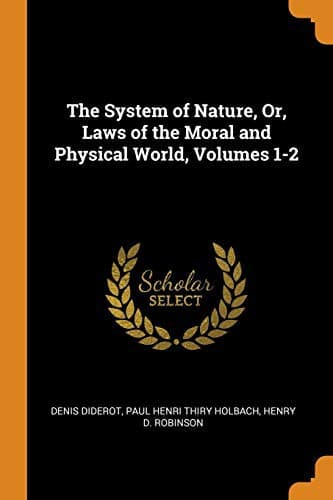
The System of Nature, or, the Laws of the Moral and Physical World. Volume 1Holbach, Paul Henri Thiry, baron d'
Religion
The System of Nature, or, the Laws of the Moral and Physical World. Volume 1
Holbach, Paul Henri Thiry, baron d'
Materialism; Philosophy and religion; Psychology
Notwithstanding, some reflections seem to favor the supposition, to
render more probable the hypothesis, that man is a production formed in
the course of time; who is peculiar to the globe he inhabits, who is the
result of the peculiar laws by which it is directed; who, consequently,
can only date his formation as coeval with that of his planet. Existence
is essential to the universe, or the total assemblage of matter
essentially varied that presents itself to our contemplation; the
combinations, the forms, however, are not essential. This granted,
although the matter of which the earth is composed has always existed,
this earth may not always have had its present form--its actual
properties; perhaps it may be a mass detached in the course of time from
some other celestial body;--perhaps it is the result of the spots, or
those encrustations which astronomers discover in the sun's disk,
which have had the faculty to diffuse themselves over our planetary
system;--perhaps the sphere we inhabit may be an extinguished or a
displaced comet, which heretofore occupied some other place in the
regions of space;--which, consequently, was then competent to produce
beings very different from those we now behold spread over its surface;
seeing that its then position, its nature, must have rendered its
productions different from those which at this day it offers to our
view.
Whatever may be the supposition adopted, plants, animals, men, can only
be regarded as productions inherent in and natural to our globe, in the
position and in the circumstances in which it is actually found: these
productions it would be reasonable to infer would be changed, if this
globe by any revolution should happen to shift its situation. What
appears to strengthen this hypothesis, is, that on our ball itself, all
the productions vary, by reason of its different climates: men, animals,
vegetables, minerals, are not the same on every part of it: they vary
sometimes in a very sensible manner, at very inconsiderable distances.
The elephant is indigenous to, or native of the torrid zone: the rein
deer is peculiar to the frozen climates of the North; Indostan is the
womb that matures the diamond; we do not find it produced in our own
country: the pine-apple grows in the common atmosphere of America; in
our climate it is never produced in the open ground, never until art has
furnished a sun analogous to that which it requires--the European in his
own climate finds not this delicious fruit. Man in different climates
varies in his colour, in his size, in his conformation, in his powers,
in his industry, in his courage, and in the faculties of his mind. But,
what is it that constitutes climate? It is the different position of
parts of the same globe, relatively to the sun; positions that suffice
to make a sensible variety in its productions.
Public-domain text, read in full here on John Shaqi.
Reviews
Reviews
No reviews yet
Be the first to share your thoughts on this work.
Elsewhere in the archive
Join the Discussion
Join the discussion
Sign in to leave a comment or review.
Sign InorCreate an account