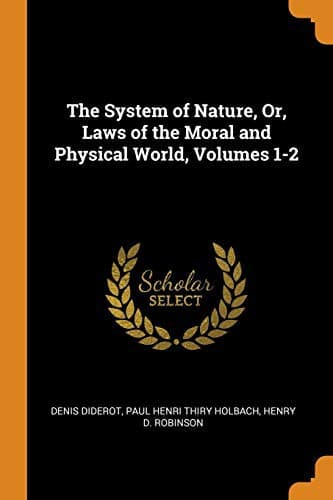
The System of Nature, or, the Laws of the Moral and Physical World. Volume 1 — John Shaqi
The System of Nature, or, the Laws of the Moral and Physical World. Volume 1Holbach, Paul Henri Thiry, baron d'
Religion
The System of Nature, or, the Laws of the Moral and Physical World. Volume 1
Holbach, Paul Henri Thiry, baron d'
Materialism; Philosophy and religion; Psychology
The same animal, by virtue of his organization, passes successively from
the most simple to the most complicated wants; it is nevertheless the
consequence of his nature. The butterfly whose beauty we admire, whose
colours are so rich, whose appearance is so brilliant, commences as
an inanimate unattractive egg; from this, heat produces a worm, this
becomes a chrysalis, then changes into that beautiful insect adorned
with the most vivid tints: arrived at this stage he reproduces,
he generates; at last despoiled of his ornaments, he is obliged to
disappear, having fulfilled the task imposed on him by Nature, having
performed the circle of transformation marked out for beings of his
order.
The same course, the same change takes place in the vegetable world. It
is by a series of combinations originally interwoven with the energies
of the aloe, that this plant is insensibly regulated, gradually
expanded, and at the end of a number of years produces those flowers
which announce its dissolution.
It is equally so with man, who in all his motion, all the changes
he undergoes, never acts but according to the laws peculiar to his
organization, and to the matter of which he is composed.
The _physical man_, is he who acts by the causes our faculties make us
understand.
The _moral man_, is he who acts by physical causes, with which our
prejudices preclude us from becoming perfectly acquainted.
The _wild man_ is a child destitute of experience, incapable of
proceeding in his happiness, because he has not learnt how to oppose
resistance to the impulses he receives from those beings by whom he is
surrounded.
The _civilized man_, is he whom experience and sociality have enabled to
draw from nature the means of his own happiness, because he has learned
to oppose resistance to those impulses he receives from exterior beings,
when experience has taught him they would be destructive to his welfare.
The _enlightened man_ is man in his maturity, in his perfection; who
is capable of advancing his own felicity, because he has learned to
examine, to think for himself, and not to take that for truth upon
the authority of others, which experience has taught him a critical
disquisition will frequently prove erroneous.
The _happy man_ is he who knows how to enjoy the benefits bestowed
upon him by nature: in other words, he who thinks for himself; who is
thankful for the good he possesses; who does not envy the welfare of
others, nor sigh after imaginary benefits always beyond his grasp.
The _unhappy man_ is he who is incapacitated to enjoy the benefits of
nature; that is, he who suffers others to think for him; who neglects
the absolute good he possesses, in a fruitless search after ideal
benefits; who vainly sighs after that which ever eludes his pursuit.
Public-domain text, read in full here on John Shaqi.
Reviews
Reviews
No reviews yet
Be the first to share your thoughts on this work.
Join the Discussion
Join the discussion
Sign in to leave a comment or review.
Sign InorCreate an account