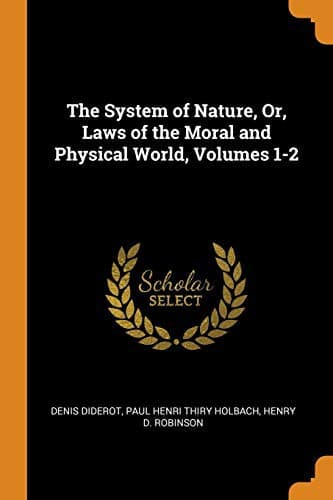
The System of Nature, or, the Laws of the Moral and Physical World. Volume 2 — John Shaqi
The System of Nature, or, the Laws of the Moral and Physical World. Volume 2Holbach, Paul Henri Thiry, baron d'
Religion
The System of Nature, or, the Laws of the Moral and Physical World. Volume 2
Holbach, Paul Henri Thiry, baron d'
Materialism; Philosophy and religion; Psychology
It remains, then, to inquire, if man can reasonably flatter himself with
obtaining a perfect knowledge of the power of nature; of the properties
of the beings she contains; of the effects which may result from their
various combinations? Do we know why the magnet attracts iron? Are
we better acquainted with the cause of polar attraction? Are we in a
condition to explain the phenomena of light, electricity, elasticity?
Do we understand the mechanism by which that modification of our brain,
which we tall volition, puts our arm or our legs into motion? Can we
render to ourselves an account of the manner in which our eyes behold
objects, in which our ears receive sounds, in which our mind conceives
ideas? All we know upon these subjects is, that they are so. If then
we are incapable of accounting for the most ordinary phenomena, which
nature daily exhibits to us, by what chain of reasoning do we refuse to
her the power of producing other effects equally incomprehensible to
us? Shall we be more instructed, when every time we behold an effect of
which we are not in a capacity to develope the cause, we may idly say,
this effect is produced by the power, by the will of God? Undoubtedly it
is the great _Cause of causes_ must have produced every thing; but is
it not lessening the true dignity of the Divinity, to introduce him as
interfering in every operation of nature; nay, in every action of so
insignificant a creature as man? As a mere agent executing his own
eternal, immutable laws; when experience, when reflection, when the
evidence of all we contemplate, warrants the idea, that this ineffable
being has rendered nature competent to every effect, by giving her those
irrevocable laws, that eternal, unchangeable system, according to which
all the beings she contains must eternally act? Is it not more worthy
the exalted mind of the GREAT PARENT OF PARENTS, _ens entium_, more
consistent with truth, to suppose that his wisdom in giving these
immutable, these eternal laws to the macrocosm, foresaw every thing that
could possibly be requisite for the happiness of the beings contained in
it; that therefore he left it to the invariable operation of a system,
which never can produce any effect that is not the best possible that
circumstances however viewed will admit: that consequently the natural
activity of the human mind, which is itself the result of this eternal
action, was purposely given to man, that he might endeavour to
fathom, that he might strive to unravel, that he might seek out the
concatenation of these laws, in order to furnish remedies against the
evils produced by ignorance. How many discoveries in the great science
of natural philosophy has mankind progressively made, which the ignorant
prejudices of our forefathers on their first announcement considered
as impious, as displeasing to the Divinity, as heretical profanations,
which could only be expiated by the sacrifice of the enquiring
Public-domain text, read in full here on John Shaqi.
Reviews
Reviews
No reviews yet
Be the first to share your thoughts on this work.
Join the Discussion
Join the discussion
Sign in to leave a comment or review.
Sign InorCreate an account