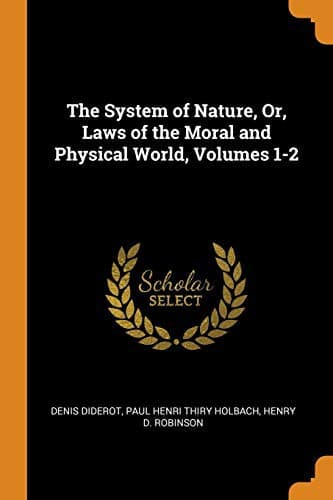
The System of Nature, or, the Laws of the Moral and Physical World. Volume 2Holbach, Paul Henri Thiry, baron d'
Religion
The System of Nature, or, the Laws of the Moral and Physical World. Volume 2
Holbach, Paul Henri Thiry, baron d'
Materialism; Philosophy and religion; Psychology
If man possessed the courage, if he had the requisite industry to recur
to the source of those opinions which are most deeply engraven on his
brain; if he rendered to himself a faithful account of the reasons which
make him hold these opinions as sacred; if he coolly examined the basis
of his hopes, the foundation of his fears, he would find that it very
frequently happens, those objects, or those ideas which move him most
powerfully, either have no real existence, or are words devoid of
meaning, which terror has conjured up to explain some sudden disaster;
that they are often phantoms engendered by a disordered imagination,
modified by ignorance; the effect of an ardent mind distracted by
contending passions, which prevent him from either reasoning justly, or
consulting experience in his judgment; that this mind often labours with
a precipitancy that throws his intellectual faculties into confusion;
that bewilders his ideas; that consequently he gives a substance and a
form to chimeras, to airy nothings, which he afterwards idolizes from
sloth, reverences from prejudice.
A sensible being placed in a nature where every part is in motion, has
various feelings, in consequence of either the agreeable or disagreeable
effects which he is obliged to experience from this continued action and
re-action; in consequence he either finds himself happy or miserable;
according to the quality of the sensations excited in him, he will love
or fear, seek after or fly from, the real or supposed causes of such
marked effects operated on his machine. But if he is ignorant of nature,
if he is destitute of experience, he will frequently deceive himself as
to these causes; for want of either capability or inclination to recur
back to them, he will neither have a true knowledge of their energy, nor
a clear idea of their mode of acting: thus until reiterated experience
shall have formed his ideas, until the mirror of truth shall have shewn
him the judgment he ought to make, he will be involved in trouble, a
prey to incertitude, a victim to credulity.
Man is a being who brings with him nothing into the world save an
aptitude to feeling in a manner more or less lively according to his
individual organization: he has no innate knowledge of any of the causes
that act upon him: by degrees his faculty of feeling discovers to him
their various qualities; he learns to judge of them; time familiarizes
him with their properties; he attaches ideas to them, according to
the manner in which they have affected him; these ideas are correct or
otherwise, in a ratio to the soundness of his organic structure:
his judgment is faulty or not, as these organs are either well or
ill-constituted; in proportion as they are competent to afford him sure
and reiterated experience.
Public-domain text, read in full here on John Shaqi.
Reviews
Reviews
No reviews yet
Be the first to share your thoughts on this work.
Join the Discussion
Join the discussion
Sign in to leave a comment or review.
Sign InorCreate an account