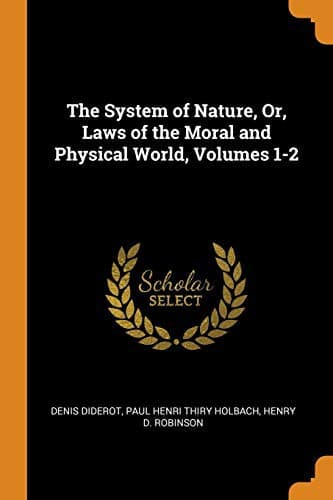
The System of Nature, or, the Laws of the Moral and Physical World. Volume 2Holbach, Paul Henri Thiry, baron d'
Religion
The System of Nature, or, the Laws of the Moral and Physical World. Volume 2
Holbach, Paul Henri Thiry, baron d'
Materialism; Philosophy and religion; Psychology
Thus, whenever man is contented, whenever every thing is in order with
respect to himself, he either admires or loves the causes to which he
believes he is indebted for his welfare; when he becomes discontented
with his mode of existence, he either fears or hates the cause which
he supposes has produced these afflicting effects. But his welfare
confounds itself with his existence; it ceases to make itself felt when
it has become habitual, when it has been of long continuance; he then
thinks it is inherrent to his essence; he concludes from it that he is
formed to be always happy; he finds it natural that every thing should
concur to the maintenance of his being. It is by no means the same when
he experiences a mode of existence that is displeasing to himself: the
man who suffers is quite astonished at the change which his taken place
in his machine; he judges it to be contrary to the entire of nature,
because it is incommodious to his own particular nature; he, imagines
those events by which he is wounded, to be contrary to the order of
things; he believes that nature is deranged every time she does not
procure for him that mode of feeling which is suitable to his ideas: he
concludes from these suppositions that nature, or rather that the agent
who moves her; is irritated against him.
It is thus that man, almost insensible to good, feels evil in a very
lively manner; the first he believes natural, the other he thinks
opposed to nature. He is either ignorant, or forgets, that he
constitutes part of a whole, formed by the assemblage of substances, of
which some are analogous, others heterogeneous; that the various beings
of which nature is composed, are endowed with a variety of properties,
by virtue of which they act diversely on the bodies who find themselves
within the sphere of their action; that some have an aptitude to
attraction, whilst it is of the essence of others to repel; that even
those bodies that attract at one distance, repel at another; that
the peculiar attractions and repulsions of the particles of bodies
perpetually oppose, invariably counteract the general ones of the masses
of matter: he does not perceive that these beings, as destitute of
goodness, as devoid of malice, act only according to their respective
essences; follow the laws their properties impose upon them; without
being in capacity to act otherwise than they do. It is, therefore, for
want of being acquainted with these things, that he looks upon the great
Author of nature, the great _Cause of causes_, as the immediate cause of
those evils to which he is submitted; that he judges erroneously when he
imagines that the Divinity is exasperated against him.
Public-domain text, read in full here on John Shaqi.
Reviews
Reviews
No reviews yet
Be the first to share your thoughts on this work.
Join the Discussion
Join the discussion
Sign in to leave a comment or review.
Sign InorCreate an account