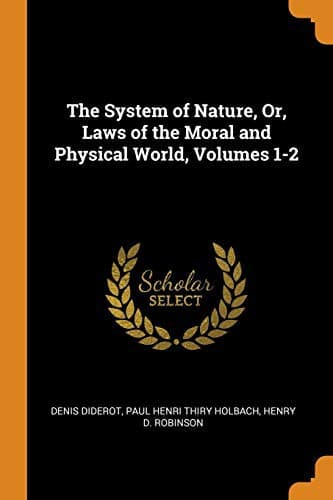
The System of Nature, or, the Laws of the Moral and Physical World. Volume 2Holbach, Paul Henri Thiry, baron d'
Religion
The System of Nature, or, the Laws of the Moral and Physical World. Volume 2
Holbach, Paul Henri Thiry, baron d'
Materialism; Philosophy and religion; Psychology
The slightest reflection, however, would have been sufficient to
undeceive him on these erroneous ideas. Everything tends to prove that
good and evil are modes of existence that depend upon causes by which a
man is moved; that a sensible being is obliged to experience them. In
a nature composed of a multitude of beings infinitely varied, the
shock occasioned by the collision of discordant matter must necessarily
disturb the order, derange the mode of existence of those beings who
have no analogy with them: these act in every thing they do after
certain laws, which are in themselves immutable; the good or evil,
therefore, which man experiences, are necessary consequences of the
qualities inherent to the beings, within whose sphere of action he is
found. Our birth, which we call a benefit, is an effect as necessary as
our death, which we contemplate as an injustice of fate: it is of the
nature of all analogous beings to unite themselves to form a whole: it
is of the nature of all compound beings to be destroyed, or to dissolve
themselves; some maintain their union for a longer period than others;
some disperse very quickly, as the ephemeron; some endure for ages, as
the planets; every being in dissolving itself gives birth to new beings;
these are destroyed in their turn; to execute the eternal, the immutable
laws of a nature that only exists by the continual changes that all
its parts undergo. Thus nature cannot be accused of malice, since every
thing that takes place in it is necessary--is produced by an invariable
system, to which every other being, as well as herself, is eternally
subjected. The same igneous matter that in man is the principle of
life, frequently becomes the principle of his destruction, either by the
conflagration of a city, the explosion of a volcano, or his mad passion
for war. The aqueous fluid that circulates through his machine, so
essentially necessary to his actual existence, frequently becomes too
abundant, and terminates him by suffocation; is the cause of those
inundations which sometimes swallow up both the earth and its
inhabitants. The air, without which he is not able to respire, is the
cause of those hurricanes, of those tempests, which frequently render
useless the labour of mortals. These elements are obliged to burst their
bonds, when they are combined in a certain manner; their necessary but
fatal consequences are those ravages, those contagions, those famines,
those diseases, those various scourges, against which man, with
streaming eyes and violent emotions, vainly implores the aid of those
powers who are deaf to his cries: his prayers are never granted; but
the same necessity which afflicted him, the same immutable laws which
overwhelmed him with trouble, replaces things in the order he finds
suitable to his species: a relative order of things which was, is, and
always will be the only standard of his judgment.
Public-domain text, read in full here on John Shaqi.
Reviews
Reviews
No reviews yet
Be the first to share your thoughts on this work.
Join the Discussion
Join the discussion
Sign in to leave a comment or review.
Sign InorCreate an account