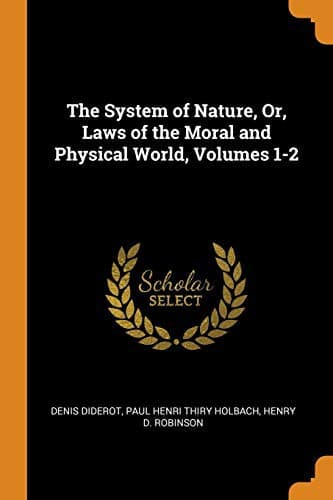
The System of Nature, or, the Laws of the Moral and Physical World. Volume 2 — John Shaqi
The System of Nature, or, the Laws of the Moral and Physical World. Volume 2Holbach, Paul Henri Thiry, baron d'
Religion
The System of Nature, or, the Laws of the Moral and Physical World. Volume 2
Holbach, Paul Henri Thiry, baron d'
Materialism; Philosophy and religion; Psychology
infancy, who never reaches maturity unless some one comes to draw him
out of his misery. At first repulsive, unsociable, intractable, he by
degrees familiarizes himself with those who render him service; once
gained by their kindness, he readily lends them his confidence; in the
end he goes the length of sacrificing to them his liberty.
It was commonly from the bosom of civilized nations that have issued
those personages who have carried sociability, agriculture, art, laws,
gods, superstition, forms of worship, to those families or hordes as yet
scattered; who united them either to the body of some other nations,
or formed them into new nations, of which they themselves became the
leaders, sometimes the king, frequently the high priest, and often their
god. These softened their manners--gathered them together--taught
them to reap the advantages of their own powers--to render each other
reciprocal assistance--to satisfy their wants with greater facility. In
thus rendering their existence more comfortable, thus augmenting
their happiness, they attracted their love; obtained their veneration,
acquired the right of prescribing opinions to them, made them adopt
such as they had either invented themselves, or else drawn up in the
civilized countries from whence they came. History points out to us the
most famous legislators as men, who, enriched with useful knowledge they
had gleaned in the bosom of polished nations, carried to savages without
industry, needing assistance, those arts, of which, until then, these
rude people were ignorant: such were the Bacchus's, the Orpheus's, the
Triptolemus's, the Numa's, the Zamolixis's; in short, all those who
first gave to nations their gods--their worship--the rudiments of
agriculture, of science, of superstition, of jurisprudence, of religion,
&c.
It will perhaps be enquired, If those nations which at the present day
we see assembled, were all originally dispersed? We reply, that this
dispersion may have been produced at various times, by those terrible
revolutions, of which it has before been remarked our globe has more
than once been the theatre; in times so remote, that history has not
been able to transmit us the detail. Perhaps the approach of more than
one comet may have produced on our earth several universal ravages,
which have at each time annihilated the greater portion of the human
species.
Public-domain text, read in full here on John Shaqi.
Reviews
Reviews
No reviews yet
Be the first to share your thoughts on this work.
Join the Discussion
Join the discussion
Sign in to leave a comment or review.
Sign InorCreate an account