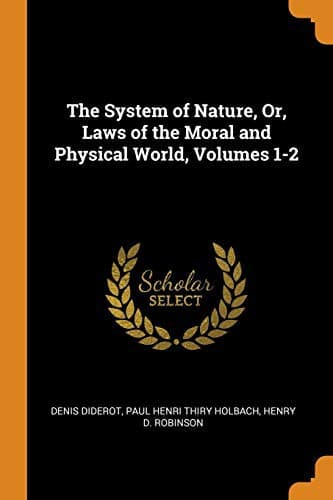
The System of Nature, or, the Laws of the Moral and Physical World. Volume 2Holbach, Paul Henri Thiry, baron d'
Religion
The System of Nature, or, the Laws of the Moral and Physical World. Volume 2
Holbach, Paul Henri Thiry, baron d'
Materialism; Philosophy and religion; Psychology
It is a problem with many people, _if truth may not be injurious?_
The best intentioned persons are frequently in great doubt upon this
important point. The fact is, _it never injures any but those who
deceive mankind_: this has, however, the greatest interest in being
undeceived. Truth may be injurious to the individual who announces it,
but it can never by any possibility harm the human species; never can it
be too distinctly presented to beings, always either little disposed to
listen to its dictates, or too slothful to comprehend its efficacy. If
all those who write to publish important truths, which, of all others,
are ever considered the most dangerous, were sufficiently ardent for the
public welfare to speak freely, even at the risk of displeasing their
readers, the human race would be much more enlightened, much happier
than it now is. To write in ambiguous terms, is very frequently to
write to nobody. The human mind is idle; we must spare it, as much
as possible, the trouble of reflection; we must relieve it from the
embarrassment of intense thinking. What time does it not consume,
what study does it not require, at the present day, to unravel the
amphibological oracles of the ancient philosophers, whose actual
sentiments are almost entirely lost to the present race of men? If truth
be useful to human beings, it is an injustice to deprive them of
its advantages; if truth ought to be admitted, we must admit its
consequences, which are also truths. Man, taken generally, is fond of
truth, but its consequences often inspire him with so much dread, so
alarm his imbecility, that, frequently, he prefers remaining in error,
of which a confirmed habit prevents him from feeling the deplorable
effects. Besides, we shall say with Hobbes, "that we cannot do men any
harm by proposing truth to them; the worst mode is to leave them in
doubt, to let them remain in dispute." If an author who writes be
deceived, it is because he may have reasoned badly. Has he laid down
false principles? It remains to examine them. Is his system fallacious?
Is it ridiculous? It will serve to make truth appear with the greatest
splendor: his work will fall into contempt; the writer, if he be witness
to its fall, will be sufficiently punished for his temerity; if he
be defunct, the living cannot disturb his ashes. No man writes with a
design to injure his fellow creatures; he always proposes to himself
to merit their suffrages, either by amusing them, by exciting their
curiosity, or by communicating to them discoveries, which he believes
useful. Above all, no work can be really dangerous, if it contains
truth. It would not be so, even if it contained principles evidently
contrary to experience--opposed to good sense. Indeed, what would
result from a work that should now tell us the sun is not luminous; that
parricide is legitimate; that robbery is allowable; that adultery is not
a crime? The smallest reflection would make us feet the falsity of these
Public-domain text, read in full here on John Shaqi.
Reviews
Reviews
No reviews yet
Be the first to share your thoughts on this work.
Elsewhere in the archive
Join the Discussion
Join the discussion
Sign in to leave a comment or review.
Sign InorCreate an account