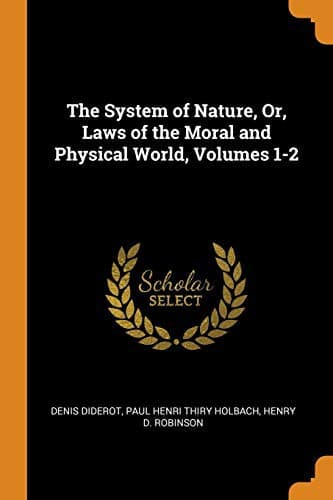
The System of Nature, or, the Laws of the Moral and Physical World. Volume 2Holbach, Paul Henri Thiry, baron d'
Religion
The System of Nature, or, the Laws of the Moral and Physical World. Volume 2
Holbach, Paul Henri Thiry, baron d'
Materialism; Philosophy and religion; Psychology
principles; the whole human race would protest against them. Men would
laugh at the folly of the author; presently his book, together with his
name, would be known only by its ridiculous extravagancies. There is
nothing but superstitious follies that are pernicious to mortals; and
wherefore? It is because authority always pretends to establish them by
violence; to make them pass for substantive virtues; rigorously punishes
those who shall be disposed to smile at their inconsistency, or examine
into their pretensions. If man was more rational, he would examine
superstitious opinions as he examines every thing else; he would look
upon theological theories with the same eyes that he contemplates
systems of natural philosophy, or problems in geometry: the latter never
disturbs the repose of society, although they sometimes excite very
warm disputes in the learned world. Theological quarrels would never
be attended with any evil consequences, if man could gain the desirable
point of making those who exercise power, feel that the disputes of
persons, who do not themselves understand the marvellous questions upon
which they never cease wrangling, ought not to give birth to any other
sensations than those of indifference; to rouse no other passion than
that of contempt.
It is, at least, this indifference not speculative theories, so just, so
rational, so advantageous for states, that sound philosophy may propose
to introduce, gradually, upon the earth. Would not the human race be
much happier--if the sovereigns of the world, occupied with the welfare
of their subjects, leaving to superstitious theologians their futile
contests, making their various systems yield to healthy politics;
obliged these haughty ministers to become citizens; carefully prevented
their disputes from interrupting the public tranquillity? What advantage
might there not result to science; what a start would be given to the
progress of the human mind, to the cause of sound morality, to
the advancement of equitable jurisprudence, to the improvement of
legislation, to the diffusion of education, from an unlimited freedom
of thought? At present, genius every where finds trammels; superstition
invariably opposes itself to its course; man, straitened with bandages,
scarcely enjoys the free use of any one of his faculties; his mind
itself is cramped; it appears continually wrapped up in the swaddling
clothes of infancy. The civil power, leagued with spiritual domination,
appears only disposed to rule over brutalized slaves, shut up in a dark
prison, where they reciprocally goad each other with the efferverscence
of their mutual ill humour. Sovereigns, in general, detest liberty
of thought, because they fear truth; this appears formidable to them,
because it would condemn their excesses; these irregularities are dear
to them, because they do not, better than their subjects, understand
their true interests; properly considered, these ought to blend
themselves into one uniform mass.
Public-domain text, read in full here on John Shaqi.
Reviews
Reviews
No reviews yet
Be the first to share your thoughts on this work.
Elsewhere in the archive
Join the Discussion
Join the discussion
Sign in to leave a comment or review.
Sign InorCreate an account