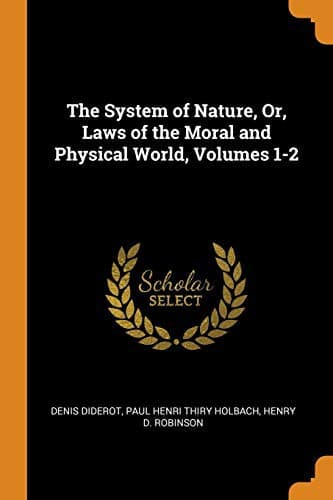
The System of Nature, or, the Laws of the Moral and Physical World. Volume 2Holbach, Paul Henri Thiry, baron d'
Religion
The System of Nature, or, the Laws of the Moral and Physical World. Volume 2
Holbach, Paul Henri Thiry, baron d'
Materialism; Philosophy and religion; Psychology
never supposed that it was nature, its various operations, its numerous
component parts--that it was the passions of man and his diverse
faculties that lay buried under an heap of allegories; they did not
perceive that the passions and faculties of human nature were used as
emblems, because man was ignorant of the true cause of the phenomena
he beheld. As strong passions seemed to hurry man along, in despite
of himself, they either attributed these passions to a god, or deified
them; frequently they did both: it was thus love became a deity; that
eloquence, poetry, industry, were transformed into gods, under the names
of Hermes, Mercury, Apollo; the stings of conscience were called the
Furies: the people, bowed down in stupid ignorance, had no eyes but
for these emblematical persons, under which nature was masked: they
attributed to their influence the good, to their displeasure the evil,
which they experienced: they entered into every kind of folly, into
the most delirious acts of madness, to render them propitious to their
views; thus, for want of being acquainted with the reality of things,
their worship frequently degenerated into the most cruel extravagance,
into the most ridiculous folly.
Thus it is obvious, that every thing proves nature and its various
parts to have every where been the first divinities of man.
Natural philosophers studied these deities, either superficially or
profoundly,--explained some of their properties, detailed some of their
modes of action. Poets painted them to the imagination of mortals,
either in the most fascinating colours, or under the most
hideous deformities; embodied them--furnished them with reasoning
faculties--recounted their exploits--recorded their will. The statuary
executed sometimes with the most enrapturing art, the ideas of the
poets,--gave substance to their shadows--form to their airy nothings.
The priest decorated these united works with a thousand marvellous
qualities--with the most terrible passions--with the most inconceivable
attributes; gave them, "a local habitation and a name." The people
adored them; prostrated themselves before these gods, who were neither
susceptible of love or hatred, goodness, or malice; they became
persecuting, malevolent, cruel, unjust, in order to render themselves
acceptable to powers generally described to them under the most odious
features.
Public-domain text, read in full here on John Shaqi.
Reviews
Reviews
No reviews yet
Be the first to share your thoughts on this work.
Join the Discussion
Join the discussion
Sign in to leave a comment or review.
Sign InorCreate an account