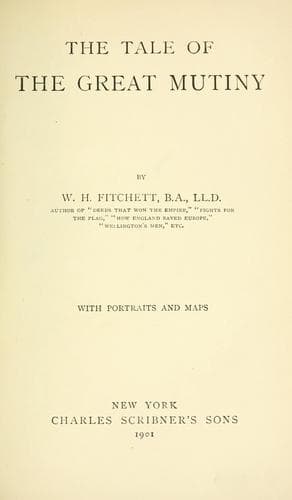
The Tale of the Great MutinyFitchett, W. H. (William Henry)
History
The Tale of the Great Mutiny
Fitchett, W. H. (William Henry)
India -- History -- Sepoy Rebellion, 1857-1858
Young Havelock, mistaking the men’s temper, galloped up to the
regiment with a message from his impatient father that lost nothing in
carrying—“If you don’t go at the village I’ll send men that will go, and
put an everlasting disgrace on you!” Brave men do not lightly endure
the whip of a message like that, and Forbes relates how a private named
Paddy Cavanagh leaped from the ranks, ran single-handed in on the enemy,
“cursing his comrades with bitter Irish malisons as he sped, and was
literally hacked to pieces, fighting like a wild cat in the ranks of his
enemies”! How the 64th followed where valiant Paddy Cavanagh had led may
be imagined; but the late arrival of the 64th had spoiled Havelock’s
combination, and he was too much given to vehement rhetoric to spare the
heavy-footed 64th a lash of the whip. “Some of you,” he said in his order
of the day next morning, “fought yesterday as if the cholera had seized
your mind as well as your bodies!”
Havelock had by this time marched fifteen miles, fought two battles,
used up one-third of his ammunition, and lost by bullet or cholera
about one-sixth of his force. At this rate of progress he would reach
Lucknow with powderless guns and 600 bayonets! Cawnpore itself, too, was
threatened, and at Dinapore, a vital point in the long water-line between
Calcutta and Allahabad, three regiments of Sepoys had broken into mutiny,
and threatened Havelock’s communications with the capital.
Havelock consulted with Tytler, his quartermaster-general, his chief
engineer, and his son. Young Havelock, with the effervescing and heady
valour of youth, was for “pushing on at all hazards”; the older men
declared this meant the entire destruction of the force, and perhaps the
loss of Lucknow, and Havelock was too good a soldier not to agree with
this view. It was an act of nobler courage to fall back than to advance,
but Havelock’s fine-tempered valour was equal to the feat, and he turned
the faces of his reluctant soldiers back to Cawnpore.
Neill, fierce and vehement by nature, when he heard the news, despatched
an amazing letter to his chief.
“You ought not to remain a day where you are,” he wrote. “You talk of
advancing as soon as reinforcements reach you. You ought to advance
again, and not halt until you have rescued, if possible, the garrison of
Lucknow.” Havelock, with that note of shrill temper which ran through his
character, was the last man to endure exhortations of this peremptory
quality from a subordinate. “There must be an end,” he wrote back, “to
these proceedings at once.” Nothing, he said, but the possible injury
to the public service prevented him from putting Neill under immediate
arrest! “But,” he added, “you now stand warned. Attempt no further
dictation!”
Public-domain text, read in full here on John Shaqi.
Reviews
Reviews
No reviews yet
Be the first to share your thoughts on this work.
Elsewhere in the archive
Join the Discussion
Join the discussion
Sign in to leave a comment or review.
Sign InorCreate an account