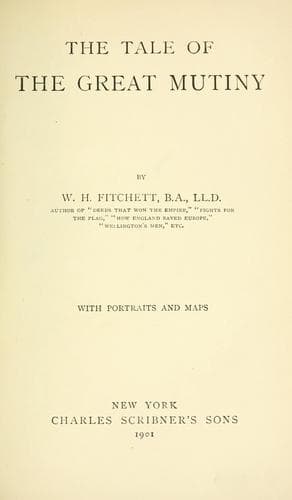
The Tale of the Great MutinyFitchett, W. H. (William Henry)
History
The Tale of the Great Mutiny
Fitchett, W. H. (William Henry)
India -- History -- Sepoy Rebellion, 1857-1858
The truth is, both men were splendid soldiers, but of a type so different
that neither could understand the other. Neill was of the silent, dour
type; Havelock was too shrill and vocal for him. Havelock, on the other
hand, often felt Neill’s stern silence to be an unsyllabled reproof, and
he more than suspected Neill of the desire to overbear him. When Neill
joined him at Cawnpore, Havelock’s first words to him were, “Now, General
Neill, let us understand each other. You have no power or authority
here whilst I am here, and you are not to issue a single order here.”
There were the elements of a very pretty quarrel betwixt the two soldiers
who were upholding the flag of England at the heart of the Mutiny; and
yet, so essentially noble were both men, and so fine was their common
standard of soldierly duty, that they laid aside their personal quarrel
absolutely, and stood by each other with flawless loyalty till, under the
fatal archway at the Kaisarbagh, Neill fell, shot through the head.
Havelock telegraphed to Calcutta that he could not resume his march
to Lucknow till he had been reinforced by 1000 infantry and Olpherts’
battery complete. Yet on August 4, when he had been reinforced by merely
a single company and two guns, he started afresh for Lucknow, won
another costly victory at Bussarat Gunj, and then fell back once more
on Cawnpore, with cholera raging amongst his men. Almost every fourth
British soldier under his command was disabled either by sickness or
wounds. Havelock had simply to wait till reinforcements came up; but he
relieved his feelings while he waited by marching out and destroying
Bithoor, Nana Sahib’s palace.
The days crept past leaden-footed; reinforcements trickled in, so to
speak, drop by drop. Not till September 16 was Havelock ready for the
final march to Lucknow. And then Outram arrived to supersede him! It
was, in a sense, a cruel stroke to Havelock. But he and Outram were tried
comrades, knitted to each other by a friendship woven of the memories
and companionship of many years, and Outram was himself one of the most
chivalrous and self-effacing men that ever lived. The story of how he
refused to take the command out of Havelock’s hands, confined himself to
his civil office as commissioner, and put himself, as a mere volunteer,
under Havelock’s orders, is an oft-told and most noble tale.
Public-domain text, read in full here on John Shaqi.
Reviews
Reviews
No reviews yet
Be the first to share your thoughts on this work.
Elsewhere in the archive
Join the Discussion
Join the discussion
Sign in to leave a comment or review.
Sign InorCreate an account