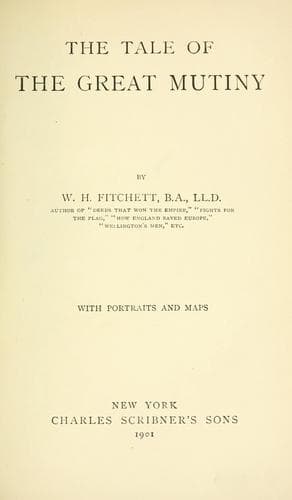
The Tale of the Great MutinyFitchett, W. H. (William Henry)
History
The Tale of the Great Mutiny
Fitchett, W. H. (William Henry)
India -- History -- Sepoy Rebellion, 1857-1858
When we halted for the night, I moved one of my guns on to the
causeway, unlimbered it, and brought it into “action front.”
The evening was just beginning to grow dusk, and the enemy
were still in sight, on the crest of some rising ground a few
hundred yards distant. The remainder of my guns were “parked”
in a nice mango-tope to the right of the road.... The first man
led out was a fine-looking young Sepoy, with good features,
and a bold, resolute expression. He begged that he might not
be bound, but this could not be allowed, and I had his wrists
tied tightly each to the upper part of a wheel of the gun. Then
I depressed the muzzle, until it pointed to the pit of his
stomach, just below the sternum. We put no shot in, and I only
kept one gunner (besides the “firing” number) near the gun,
standing myself about 10 ft. to the left rear. The young Sepoy
looked undauntedly at us during the whole process of pinioning;
indeed, he never flinched for a moment. Then I ordered the
port-fire to be lighted, and gave the word “Fire!” There was a
considerable recoil from the gun, and a thick cloud of smoke
hung over us. As this cleared away, we saw two legs lying in
front of the gun, but no other sign of what had, just before,
been a human being and a brave man. At this moment, perhaps
from six to eight seconds after the explosion, down fell the
man’s head among us, slightly blackened, but otherwise scarcely
changed. It must have gone straight up into the air, probably
about 200 feet.
This was stern, uncanny occupation for a humane-minded British officer!
But the times were stern, the crisis supreme.
On the evening of the second day’s march the air was full of a faint,
far-off, vibrating sound. It was the distant roar of the enemy’s cannon
breaking like some angry and dreadful sea on the besieged Residency!
When the camp was pitched Havelock fired a royal salute, hoping the
sound would reach the ears of the beleaguered garrison, and tell them
rescue was coming; but the faint wind failed to carry the sound to the
Residency. When the soldiers began their march on September 23, Lucknow
was only sixteen miles distant, and by noon the Alumbagh was in sight,
held by a force of some 12,000 men.
Havelock turned the enemy’s right with his second brigade, while he
engaged the enemy’s guns with Eyre’s battery in front. Olpherts, with his
guns, was sent to assist the turning movement. Here is a stirring battle
picture drawn by Forbes:—
Public-domain text, read in full here on John Shaqi.
Reviews
Reviews
No reviews yet
Be the first to share your thoughts on this work.
Elsewhere in the archive
Join the Discussion
Join the discussion
Sign in to leave a comment or review.
Sign InorCreate an account