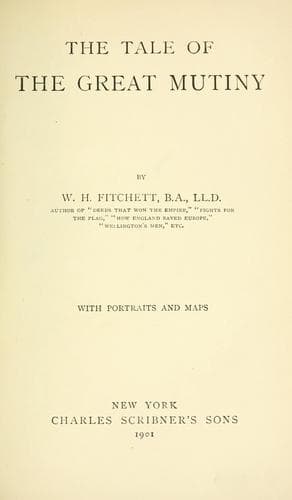
The Tale of the Great MutinyFitchett, W. H. (William Henry)
History
The Tale of the Great Mutiny
Fitchett, W. H. (William Henry)
India -- History -- Sepoy Rebellion, 1857-1858
At a stretching gallop, with some volunteer cavalry in front
of it, the horse battery dashed up the road past the halted
first brigade, which cheered loudly as the cannon swept by,
Neill waving his cap and leading the cheering. On the left of
the road there was a great deep trench full of water, which
had somehow to be crossed. Led by Barrow, the cavalry escort
plunged in, and scrambled through, and then halted to watch
how Olpherts would conquer the obstacle. “Hell-fire Jack” was
quite equal to the occasion, and his men were as reckless as
himself. With no abatement of speed the guns were galloped into
the great trough. For a moment there was chaos—a wild medley of
detachments, drivers, guns, struggling horses, and splashing
water; and then the guns were out on the further side, nobody
and nothing the worse for the scramble, all hands on the alert
to obey Olpherts’ stentorian shout, “Forward at a gallop!”
Hamilton’s men marched and fought knee-deep in water; but the enemy’s
right was smashed, his centre tumbled into ruin, and the men of the
78th and the Fusileers actually carried the Alumbagh in ten minutes! To
tumble 12,000 men into flight, and carry the Alumbagh in this fashion,
and in a space so brief, was a great feat; and while the men were
in the exultation of victory, a messenger came riding in with the
news—unhappily not true—that Delhi had fallen!
On the 24th the little force rested, while its leaders matured their
plans for the advance to the Residency. Before them ran the great canal,
the road crossing it by what was called the Charbagh bridge. Havelock’s
plan was to bridge the Goomtee, the river into which the canal ran, march
along its further bank, round the city to its north-west angle, and
re-cross by the iron bridge immediately in front of the Residency, and
in this way avoid the necessity of forcing his way, with desperate and
bloody street-fighting, through the interlaced and tangled lanes of the
city.
But the soil between the canal and the river was little better than a
marsh, and it was determined to force the Charbagh bridge, advance on a
lane which skirted the left bank of the canal, then turn sharply to the
left, and fight a way across the city to the Residency.
Public-domain text, read in full here on John Shaqi.
Reviews
Reviews
No reviews yet
Be the first to share your thoughts on this work.
Elsewhere in the archive
Join the Discussion
Join the discussion
Sign in to leave a comment or review.
Sign InorCreate an account