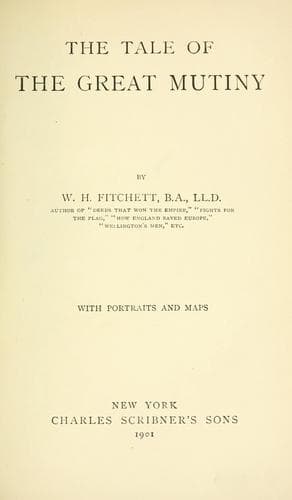
The Tale of the Great MutinyFitchett, W. H. (William Henry)
History
The Tale of the Great Mutiny
Fitchett, W. H. (William Henry)
India -- History -- Sepoy Rebellion, 1857-1858
Kavanagh was an Irishman, a clerk in one of the civil offices, and
apparently possessed a hundred disqualifications for the business of
making his way, disguised as a native, through the dark-faced hordes that
kept sleepless watch round the Residency, and through the busy streets
of Lucknow beyond. He was a big-limbed, fair man, with aggressively
red hair, and uncompromisingly blue eyes! By what histrionic art could
he be “translated,” in Shakespeare’s sense, into a spindle-shanked,
narrow-shouldered, dusky-skinned Oude peasant? But Kavanagh was a man of
quenchless courage, with a more than Irish delight in deeds of daring,
and he had a perfect knowledge of native dialect and character. He has
left a narrative of his adventure.
A spy had come in from Campbell, and was to return that night, and
Kavanagh conceived the idea of going out with him, and acting as guide
to the relieving force. Outram hesitated to permit the attempt to be
made, declaring it to be too dangerous; but Kavanagh’s eagerness for
the adventure prevailed. He hid the whole scheme from his wife, and,
at half-past seven o’clock that evening, when he entered Outram’s
headquarters, he was so perfectly disguised that nobody recognised him.
He had blackened his face, neck, and arms with lamp-black, mixed with
a little oil. His red hair, which even lamp-black and oil could hardly
subdue to a colder tint, was concealed beneath a huge turban. His dress
was that of a budmash, or irregular native soldier, with sword and
shield, tight trousers, a yellow-coloured chintz sheet thrown over the
shoulders, and a white cummerbund.
A little after eight o’clock Kavanagh, with his native guide, crept
to the bank of the Goomtee, which ran to the north of the Residency
entrenchment. The river was a hundred yards wide, and between four feet
and five feet deep. Both men stripped, crept down the bank, and slipped,
as silently as otters, into the stream. Here for a moment, as Kavanagh in
his narrative confesses, his courage failed him. The shadowy bank beyond
the black river was held by some 60,000 merciless enemies. He had to pass
through their camps and guards, and through miles of city streets beyond.
If detected, he would certainly perish by torture. “If my guide had been
within my reach,” he says, “I should perhaps have pulled him back and
abandoned the enterprise.” But the guide was already vanishing, a sort of
crouching shadow, into the blackness of the further bank; and, hardening
his heart, Kavanagh stole on through the sliding gloom of the river.
Public-domain text, read in full here on John Shaqi.
Reviews
Reviews
No reviews yet
Be the first to share your thoughts on this work.
Elsewhere in the archive
Join the Discussion
Join the discussion
Sign in to leave a comment or review.
Sign InorCreate an account