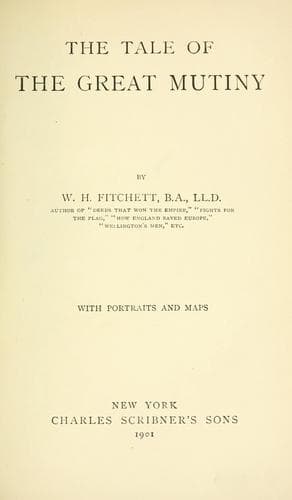
The Tale of the Great MutinyFitchett, W. H. (William Henry)
History
The Tale of the Great Mutiny
Fitchett, W. H. (William Henry)
India -- History -- Sepoy Rebellion, 1857-1858
Both men crept up a ditch that pierced the river-bank to a cluster of
trees, and there dressed; and then, with his tulwar on his shoulder and
the swagger of a budmash, Kavanagh went boldly forward with his guide.
A matchlock man first met the adventurous pair and peered suspiciously
at them from under his turban. Kavanagh in a loud voice volunteered
the remark that “the night was cold,” and passed on. They had to cross
the iron bridge which spanned the Goomtee, and the officer on guard
challenged them lazily from the balcony of a two-storeyed house. Kavanagh
himself hung back in the shade, while his guide went forward and told
the story of how they belonged to a village some miles distant, and were
going to the city from their homes.
They were allowed to pass, ran the gauntlet of many troops of Sepoys,
re-crossed the Goomtee by what was called the stone bridge, and passed
unsuspected along the principal street of Lucknow, jostling their way
through the crowds, and so reached the open fields beyond the city.
“I had not been in green fields,” writes Kavanagh, “for five months.
Everything around us smelt sweet, and a carrot I took from the roadside
was the most delicious thing I had ever tasted!” But it was difficult to
find their way in the night. They wandered into the Dilkusha Park, and
stumbled upon a battery of guns, which Kavanagh, to the terror of his
guide, insisted upon inspecting.
They next blundered into the canal, but still wandered on, till they
fell into the hands of a guard of twenty-five Sepoys, and Kavanagh’s
guide, in his terror, dropped in the dust of the road the letter he was
carrying from Outram to Campbell. Kavanagh, however, kept his coolness,
and after some parleying he and his guide were allowed to pass on. The
much-enduring pair next found themselves entangled in a swamp, and,
waist-deep in its slime and weeds, they struggled on for two hours, when
they reached solid ground again. Kavanagh insisted on lying down to rest
for a time. Next they crept between some Sepoy pickets which, with true
native carelessness, had thrown out no sentries, and finally, just as the
eastern sky was growing white with the coming day, the two adventurers
heard the challenge, “Who comes there?” from under the shadow of a great
tree!
It was a British cavalry picket, and Kavanagh had soon the happiness
of pouring into Sir Colin Campbell’s ears the messages and information
he brought, while a flag, hoisted at twelve o’clock on the summit of
the Alumbagh, told Outram that his messenger had succeeded, and that
both the garrison and the relieving force had now a common plan. It is
difficult to imagine a higher example of human courage than that supplied
by “Lucknow” Kavanagh, as he was afterwards called, and never was the
Victoria Cross better won.
Public-domain text, read in full here on John Shaqi.
Reviews
Reviews
No reviews yet
Be the first to share your thoughts on this work.
Elsewhere in the archive
Join the Discussion
Join the discussion
Sign in to leave a comment or review.
Sign InorCreate an account