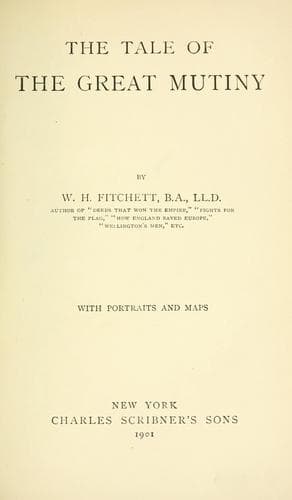
The Tale of the Great MutinyFitchett, W. H. (William Henry)
History
The Tale of the Great Mutiny
Fitchett, W. H. (William Henry)
India -- History -- Sepoy Rebellion, 1857-1858
Lawrence shone as a youth neither in studies nor in games, and both
as a youth and man he had a magnificent faculty for silence. By blood
and genius he was a soldier. But duty was the supreme law of life for
him; and at the bidding of what he deemed to be duty, he surrendered
a soldier’s career and entered the Indian Civil Service. His silent
energy, his strong brain, his passion for work, his chivalrous loyalty
to righteousness, quickly assured him a great career. He was above the
middle height, strongly built, with an eager, forward gait. His massive
head gave him a sort of kingly look—the forehead broad, the eyes deep-set
and grey, but with a gleam in them as of a sword-blade. The firm lips had
a saddened curve; the face was ploughed deep with furrows of thought and
work. His voice, when his feelings were aroused, had a singular resonance
and timbre, and his whole aspect was that of silent, half-melancholy
simplicity and strength.
But Lawrence was exactly the man for a great crisis. He had a kingly
faculty for choosing fit instruments. He saw with perfect clearness
every detail of the visible landscape; but he had also that subtler
vision—which only great poets and great statesmen possess—of the
tendencies and forces which underlie external facts and determine their
flow. The Celtic element in him, perhaps, gave Lawrence that rare and
subtle faculty; but by virtue of his Scottish strain he was essentially a
man of action. He could grasp a great purpose with a hand of steel, and
hold it unshaken through all the shocks of conflict and adversity.
Lawrence, it may be added, was pre-eminently fortunate in his officers.
Partly by the attraction which draws like to like, and partly by his
own rare genius for choosing fit instruments, he had gathered round him
a group of splendid soldiers and administrators, all in the prime of
life. Nicholson, for example, was only thirty-five; Edwardes and Neville
Chamberlain only thirty-seven. The general average of age, indeed, on
Lawrence’s staff was much below that of India in general. All the energy
of youth, in brief, was in Lawrence’s men; all the sagacity of ripest
statesmanship was in Lawrence himself.
Public-domain text, read in full here on John Shaqi.
Reviews
Reviews
No reviews yet
Be the first to share your thoughts on this work.
Elsewhere in the archive
Join the Discussion
Join the discussion
Sign in to leave a comment or review.
Sign InorCreate an account