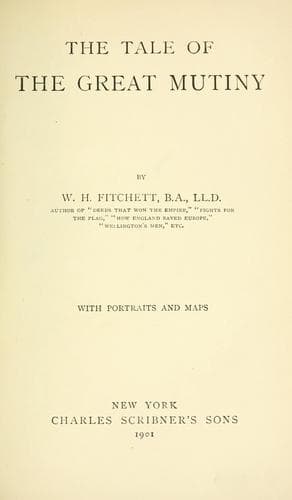
The Tale of the Great MutinyFitchett, W. H. (William Henry)
History
The Tale of the Great Mutiny
Fitchett, W. H. (William Henry)
India -- History -- Sepoy Rebellion, 1857-1858
The mutineers from Meerut rode into Delhi on May 11. It was the city
of the Great Mogul. It appealed by a thousand memories to both the
race-pride and the fanaticism of the revolted Sepoys. Here the Mutiny
found, not only a natural stronghold, but an official head, and Delhi
thus became a far-seen signal of revolt to the whole of Northern India.
But on June 7—or less than four weeks after Willoughby in heroic despair
blew up the great magazine at Delhi—Sir Henry Barnard’s microscopic army
made its appearance on the Ridge, and the siege of Delhi began. It was
a real stroke of military genius that thus, from the earliest outbreak
of the Mutiny, kept a bayonet, so to speak, pointed threateningly at its
very heart!
And the hero of the siege of Delhi is not Barnard, or Wilson, or
Baird-Smith, or Neville Chamberlain, or Nicholson—but a man who never
fired a shot or struck a sword-stroke in the actual siege itself—John
Lawrence. Lawrence, and not Havelock, nor Outram, nor Canning, was the
true saviour of the British _raj_ in India in the wild days of the Mutiny.
John Lawrence was five years younger than his gallant brother Henry,
who died in the Residency at Lucknow. He had no visible gleam of the
brilliancy which makes Henry Lawrence a character so attractive. Up to
middle life, indeed, John Lawrence was a silent, inarticulate, rugged
man, with the reputation of being a great worker, but whom nobody
suspected to be a genius, and for whom nobody—least of all Lawrence
himself—dreamed fame was waiting. He came of that strong-bodied,
strong-brained, masterful race of which the North of Ireland is the
cradle. But England, Ireland, and Scotland all had a share in the
making of John Lawrence. He was actually born in England. His father
was a gallant Irish soldier, who led the forlorn hope at the storming
of Seringapatam. His mother was a lineal descendant of John Knox, the
Scottish reformer. And perhaps the characteristic traits of the three
countries never met more happily in a single human character than in John
Lawrence. In Ulster he was known amongst his schoolmates as “English
John.” At Haileybury, in England, he was looked upon as a typical
Irishman.
The truth is, he was Englishman, Irishman, Scotchman all in one. He had
Celtic glow and fire under a crust of Scottish silence and caution; and
he added the Englishman’s steady intelligence and passion for justice to
Scottish hard-headedness and the generous daring of the Irish character.
Or, to put the matter in a different way, in any perilous crisis he
could survey the situation with the balanced judgment of an Englishman;
could choose his course with the shrewd and calculating sagacity of a
Scotchman; then carry it out with Irish fire and daring!
Public-domain text, read in full here on John Shaqi.
Reviews
Reviews
No reviews yet
Be the first to share your thoughts on this work.
Elsewhere in the archive
Join the Discussion
Join the discussion
Sign in to leave a comment or review.
Sign InorCreate an account