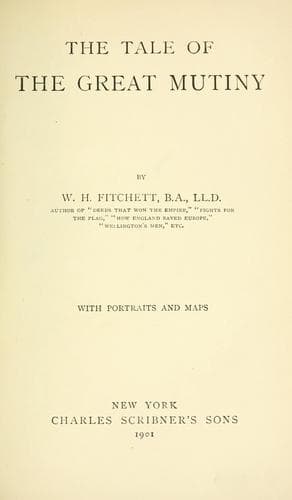
The Tale of the Great MutinyFitchett, W. H. (William Henry)
History
The Tale of the Great Mutiny
Fitchett, W. H. (William Henry)
India -- History -- Sepoy Rebellion, 1857-1858
There can be no doubt that Edwardes showed, at this moment, not only
the more heroic temper, but the sounder judgment of the two. Canning
settled the dispute. “Hold on to Peshawur to the last,” he wrote; and
the question was decided. But Lawrence’s momentary lapse into indecision
only sets in more dazzling light his courage afterwards. It was after
he had seriously meditated abandoning the Punjaub that he despatched
the immortal movable column, under Nicholson, 4200 strong, with a
powerful battering-train, to Delhi, thus feeding the gallant force on the
Ridge with his own best troops, and yet not giving up “an inch of the
frontier,” or abating one whit of his own haughty rule in the Punjaub!
General Anson, as we have seen, was commander-in-chief in India when
the Mutiny broke out. He was a brave man, had fought as an ensign at
Waterloo, and had seen forty-three years’ bloodless service after that
great battle. But his gifts were rather social than soldierly. He was a
better authority on whist and horses than on questions of tactics and
strategy, and he was scarcely the man to face an army in revolt. Lawrence
acted as a military brain and conscience for Anson, and determined that
Delhi must be attacked; though, as a matter of fact, Anson had only
three regiments of British troops, almost no artillery, and absolutely no
transport at his command.
On May 16 Anson held a council of war with his five senior officers at
Umballa, and the council agreed unanimously that, with the means at
Anson’s command, nothing could be done. It is a curious fact, showing
the speed with which, from this point, events moved, that, within less
than two months from the date of that council, all its members were
dead—either killed in battle, or killed by mere exposure and strain! But
Lawrence’s views prevailed. “Pray, only reflect on the whole history
of India,” he wrote to Anson. “Where have we failed when we have acted
vigorously? Where have we succeeded when guided by timid counsels?”
Anson and his advisers gave that highest proof of courage which brave
men can offer: they moved forward without a murmur on an adventure which
they believed to be hopeless. From an orthodox military point of view it
was hopeless. Only, the British empire in India has been built up by the
doing of “hopeless” things.
On May 24 Anson reached Kurnal, where his troops were to arrive four days
afterwards. On the 26th Anson himself was dead, killed by cholera after
only four hours’ illness!
Public-domain text, read in full here on John Shaqi.
Reviews
Reviews
No reviews yet
Be the first to share your thoughts on this work.
Elsewhere in the archive
Join the Discussion
Join the discussion
Sign in to leave a comment or review.
Sign InorCreate an account