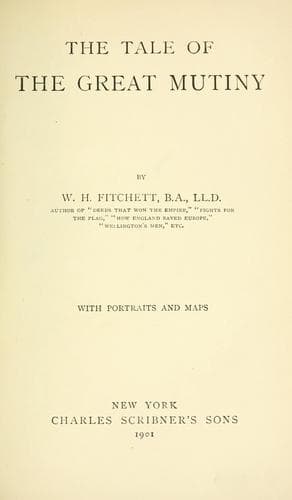
The Tale of the Great MutinyFitchett, W. H. (William Henry)
History
The Tale of the Great Mutiny
Fitchett, W. H. (William Henry)
India -- History -- Sepoy Rebellion, 1857-1858
The revolted Sepoys, on their side, were full of a fierce energy quite
unusual to them, and on the very first day they flung themselves in great
numbers, and with great daring, on the detachment holding Hindu Rao’s
house. Two companies of the 60th held this post, with two guns from
Scott’s battery; and for half the afternoon the quick flashes, the white
smoke of cannon, and the incessant rattle of musketry round the assailed
post told with what fury the attack was being urged, and how stubbornly
the defence was being maintained.
At last the cavalry of the newly-arrived Guides was sent at the enemy.
They rode in upon the Sepoys with magnificent courage, broke them into
flying fragments, and pursued them, wounding and slaying, to the walls
of the city. Their victory was brilliant, but it was dearly bought,
their commander, Quentin Battye, being mortally wounded. He was little
more than a lad, but was almost worshipped by his dark-faced horsemen.
He had been an English public-school boy, and, Lord Roberts says, was
curiously fond of quotations. Almost his last words, spoken to a friend,
were, “Good-bye! ‘Dulce et decorum est pro patria mori.’ That’s how it
is with me, old fellow!” The victories of England are still won, as in
Wellington’s days, on the playing grounds of its great schools.
The Guides found in the camp a soldier of mingled yet splendid fame who
had been their leader in many a gallant charge—Hodson, of Hodson’s Horse.
Hodson had been, rightly or wrongly, under a cloud; but the crisis of
the Mutiny naturally gave, to the most daring horseman and the most
brilliant light cavalry leader in India, a great opportunity. He was
now at the head of a body of irregular horse, and one of Barnard’s most
trusted officers. He was tall, fair-haired, with bloodless complexion,
heavy curved moustache, and keen, alert, and what some one called
“unforgiving” eyes.
When the Guides, as they rode into the camp, met Hodson, a curious
scene took place. They crowded round him with wild gesticulations and
deep-voiced, guttural shouts. “They seized my bridle,” says Hodson
himself, “my dress, hands, and feet, and literally threw themselves
down before the horse with tears streaming down their faces!” Hodson
was the ideal leader for fierce irregulars like the Guides, a brilliant
swordsman, of iron nerve, and courage as steadfast as the blade of his
own sword. And with leaders like Daly, and Hodson, and Reid, and Battye,
Sikhs and Ghoorkas made soldiers that might have charged through Russian
Life Guards, or broken a square of Pomeranian Grenadiers!
Public-domain text, read in full here on John Shaqi.
Reviews
Reviews
No reviews yet
Be the first to share your thoughts on this work.
Elsewhere in the archive
Join the Discussion
Join the discussion
Sign in to leave a comment or review.
Sign InorCreate an account