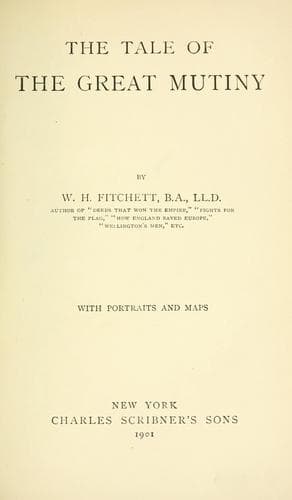
The Tale of the Great MutinyFitchett, W. H. (William Henry)
History
The Tale of the Great Mutiny
Fitchett, W. H. (William Henry)
India -- History -- Sepoy Rebellion, 1857-1858
On June 10 the Sepoys delivered another attack, in great strength, on
Hindu Rao’s house, which they looked upon as the key of the British
position, and which was held on this day by the Ghoorkas under Reid. The
Sepoys hoped that the Ghoorkas would join them, and, as they came on,
instead of firing, they waved their hands, and shouted, “Don’t fire. We
are not firing. We want to speak to you. Come and join us.” “Oh yes! we
are coming,” answered the sturdy little Ghoorkas, with fierce, jesting
humour, and, running forward to within thirty yards of the Sepoys, they
poured a quick and deadly fire upon them, driving them back with great
slaughter. From that stage of the siege, Hindu Rao’s house, perhaps the
most fiercely attacked point in the British front, was held by Reid and
his Ghoorkas, and a better officer or better men were not to be found on
the Ridge.
The more eager spirits among the British were burning to leap on the
city, and, on June 12, a plan of attack was actually prepared by the
engineer officers and Hodson, and approved by Barnard. The whole force
was to be divided into three columns; one was to break its way through
the Cashmere Gate, a second through the Lahore Gate, a third was to fling
itself on the walls, and attempt an escalade—practically, the same plan
by which the city was finally carried. It was a project, considering
the force available for its execution, almost insane in its daring; and
Barnard, though he consented to it, took no decided and methodical steps
to carry it out.
It would almost seem, indeed, as if physical strain, want of sleep, and
the terrible responsibility he was carrying, had affected Barnard’s head.
The situation might well have taxed—and over-taxed—the brain of a greater
general than Barnard. The light guns of the British, firing at a distance
of a thousand yards, could make no impression on the walls. Their
strength was dwindling daily; that of the enemy was growing fast. And it
was natural that the British temper, under such conditions, should become
explosive, and that the more daring spirits were eager, in the face of
any risks, to come to the sword’s point with their enemies. The General’s
nerve was curiously shaken. Hope Grant tells how Sir Henry Barnard sent
for him on the evening of the 12th: “He hushed me into a whisper, and
asked me if I thought any person could possibly overhear us, adding,
‘There is treason around us.’ Then he explained, ‘I mean to attack the
town to-night.’” Barnard’s manner produced on Hope Grant’s mind the
impression that his brain was slightly off its balance.
Public-domain text, read in full here on John Shaqi.
Reviews
Reviews
No reviews yet
Be the first to share your thoughts on this work.
Elsewhere in the archive
Join the Discussion
Join the discussion
Sign in to leave a comment or review.
Sign InorCreate an account