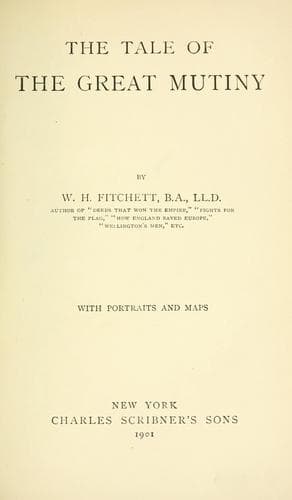
The Tale of the Great MutinyFitchett, W. H. (William Henry)
History
The Tale of the Great Mutiny
Fitchett, W. H. (William Henry)
India -- History -- Sepoy Rebellion, 1857-1858
Hope Grant collected a few men, and rode fiercely into the enemy’s ranks.
His horse was shot, and, galloping wildly into the mass of Sepoys, fell
dead. Hope Grant was thus left unhorsed in the darkness, and in the midst
of the enemy! His orderly, a fine, tall Sowar, who had remained loyal
when his regiment mutinied, was in a moment by his side, and cried,
“Take my horse; it is your only chance of safety.” Hope Grant refused
the generous offer, and, taking a firm grasp of the horse’s tail, bade
the Sowar drag him out of the _mêlée_. The next day Hope Grant sent for
the Sowar, warmly praised his gallant conduct, and offered him a reward
in money. The brave fellow drew himself up with dignity, salaamed, and
said, “No, Sahib, I will take no money.”
Seaton describes how, during that wild night combat, they watched, from
the Ridge above, the flashes of the guns, rending the gloom with darting
points of flame, and listened to the shouts, the clash of weapons, the
crackle of the musketry that marked the progress of the fight. Presently
there came a sudden glare, then a roar that for a moment drowned all
other sounds. One of the British limbers had blown up. The fight was
going badly. Then, out of the darkness, came the cry of a human voice,
“Where is the General?” It was an officer asking reinforcements, and
three companies of the 1st Fusileers, who were standing hard by, silent
and invisible in the dusk, were sent down to the fight. They moved
forward at the curt word of command: presently the rolling crash of their
volleys was heard; a line of red, dancing points of fire through the
darkness marked their progress, and the guns were saved!
June 23 was the centenary of Plassey, and a prediction, widely spread
amongst the Sepoys, announced that on that day the _raj_ of the British
was to end. As it happened, that particular day was also a great
religious festival for the Hindus, whilst it was the day of the new moon,
and so was held by Mohammedans as a fortunate day. Accordingly an attack
of great fury, and maintained for eight long hours, was made on the
British right. Some reinforcements, amounting to 850 men, were on the
22nd within twenty miles of Delhi, and a staff officer was despatched to
hurry them on; and they actually reached the Ridge in time to take part
in the final effort which drove back the enemy. Roberts says that “no men
could have fought better than did the Sepoys. They charged the Rifles,
the Guides, and the Ghoorkas again and again.” But nothing could shake
the cool and obstinate—the almost scornful—valour of the British.
Public-domain text, read in full here on John Shaqi.
Reviews
Reviews
No reviews yet
Be the first to share your thoughts on this work.
Elsewhere in the archive
Join the Discussion
Join the discussion
Sign in to leave a comment or review.
Sign InorCreate an account