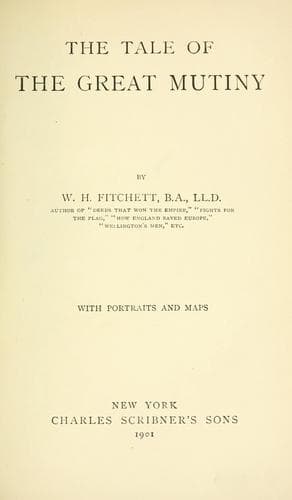
The Tale of the Great MutinyFitchett, W. H. (William Henry)
History
The Tale of the Great Mutiny
Fitchett, W. H. (William Henry)
India -- History -- Sepoy Rebellion, 1857-1858
At one o’clock that night the troops were suddenly paraded, ammunition
served out, and leaders assigned to the three columns. But the 75th Foot
had, somehow, been left at the extreme front without orders, and before
they could be brought up the grey dawn was breaking, and the proposed
attack had to be abandoned. Lord Roberts says that this “blunder” was
“a merciful dispensation, which saved the British from an irreparable
disaster.” That was not Hodson’s judgment. In his journal he says: “The
attack was frustrated by the fears and absolute disobedience to orders
of ⸺, the man who first lost Delhi, and has now, by his folly, prevented
its being recaptured.” But Hodson was more impatient and blunt-spoken
than is permissible to even a gallant soldier, and his diary reflects,
perhaps, rather the condition of his liver than the deliberate judgment
of his head. Thus he writes: “That old woman ⸺, has come here for nothing
apparently, but as an obstacle; ⸺ is also a crying evil to us!”
On the 12th, indeed, the Sepoys themselves were attacking Flagstaff
Tower with great fury, but were repelled with steady valour. On June 14,
General Reed arrived in camp; he was in chief divisional command, and
should at once have taken over the charge of the siege from Barnard; but
a ride of 500 miles had left him little better than a physical wreck, and
Barnard still remained in command.
On the 13th, 14th, and 15th there were new attacks pluckily urged by
the Sepoys, and repelled with cool and stern courage by the British.
“They came on,” is Hodson’s summary, “very boldly, and got most heartily
thrashed.” On the 17th the British were attacked along their whole front,
and from almost every direction, and an attempt was made to construct a
battery which would enfilade the Ridge. Two small columns, under Tombs
and Reid, were sent out with a dash, broke up the proposed battery in
brilliant style, and drove the troops that covered it in wild and bloody
flight to the city walls.
Week after week the fighting went on most gallantly, and the story gleams
with records of shining pluck; it rings with the clash of steel on steel;
it thrills to the rattle of musketry volleys and the deeper voice of the
cannon. Thus Hope Grant tells how, on the night of the 19th, from sunset
till half-past eleven, he kept back, by repeated charges of squadrons
of the 9th Lancers and the Guides, with the help of some field-guns, an
attack on the rear of the British position.
The fighting was close and furious. As Daly came up through the darkness
into the fight, Tombs said, “Daly, if you don’t charge, my guns are
taken;” and Daly, shaking his reins, and followed by a handful of his
Guides, dashed on the enemy, and saved the guns. Colonel Yule, of the 9th
Lancers, was killed; Daly himself was severely wounded; and the enemy,
in the dark, worked round the flanks of the British guns, and two of the
pieces were on the point of being taken.
Public-domain text, read in full here on John Shaqi.
Reviews
Reviews
No reviews yet
Be the first to share your thoughts on this work.
Elsewhere in the archive
Join the Discussion
Join the discussion
Sign in to leave a comment or review.
Sign InorCreate an account