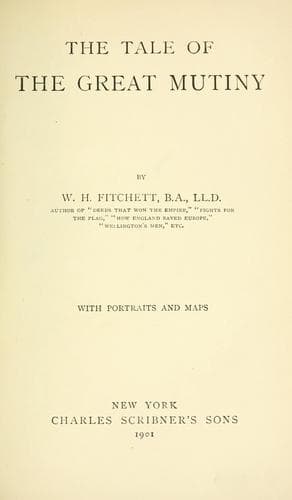
The Tale of the Great MutinyFitchett, W. H. (William Henry)
History
The Tale of the Great Mutiny
Fitchett, W. H. (William Henry)
India -- History -- Sepoy Rebellion, 1857-1858
Not liking to waste it, we looked round us, and saw a group of
officers on the steps of the church, apparently engaged in an
animated conversation. Among them was an old man, who looked as
if a good “peg” (the common term for a brandy and soda) would
do him good. Drawing, therefore, nearer the group, in order to
offer the “peg” to the old officer, we heard our colonel say,
“All I can say is that I won’t retire, but will hold the walls
with my regiment.” I then offered our “peg” to the old officer,
whom we afterwards knew to be General Wilson. He accepted it,
drank it off, and a few minutes after we heard him say, “You
are quite right—to retire would be to court disaster; we will
stay where we are!”
“On such little matters,” Wilberforce gravely reflects, “great events
often depend!” The course of British history in India, in a word, was
decisively affected by that accidental glass of brandy and soda he
offered to General Wilson! It tightened his shaken nerves to the key of
resolution! Wilberforce’s book belongs rather to the realm of fiction
than of grave history, and his history-making glass of brandy and soda
may be dismissed as a flight of fancy. It was the cool judgment and the
unfaltering daring of men like Baird Smith and Neville Chamberlain, and
other gallant spirits immediately around Wilson, which saved him from
the tragedy of a retreat. When Wilson asked Baird Smith whether it was
possible to hold the ground they had won, the curt, decisive answer of
that fine soldier was, “We _must_ hold it!” And that white flame of
heroic purpose burnt just as intensely in the whole circle of Wilson’s
advisers.
The British troops held their position undisturbed on the night of the
14th. The 15th was spent in restoring order and preparing for a new
assault. There is a curious conflict of testimony as to whether or not
the troops had got out of hand owing to mere drunkenness. It is certain
that enormous stores of beer, spirits, and wine were found in that
portion of the city held by the British. Lord Roberts says, “I did not
see a single drunken man throughout the day of assault, and I visited
every position held by our troops within the walls of the city.” This bit
of evidence seems final. Yet it would be easy to quote a dozen witnesses
to prove that there was drunkenness to a perilous extent amongst the
troops, and it is certain that Wilson found it expedient to give orders
for the destruction of the whole of the vast stores of beer and spirits
which had fallen into his hands.
Public-domain text, read in full here on John Shaqi.
Reviews
Reviews
No reviews yet
Be the first to share your thoughts on this work.
Elsewhere in the archive
Join the Discussion
Join the discussion
Sign in to leave a comment or review.
Sign InorCreate an account