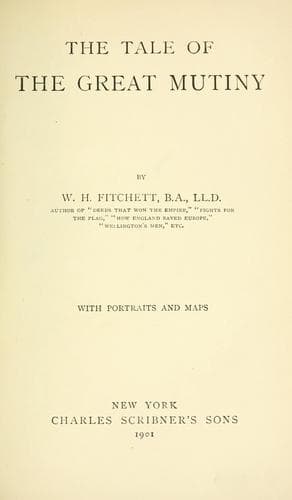
The Tale of the Great MutinyFitchett, W. H. (William Henry)
History
The Tale of the Great Mutiny
Fitchett, W. H. (William Henry)
India -- History -- Sepoy Rebellion, 1857-1858
A new plan of attack was devised by the engineers. Batteries were armed
with guns captured from the enemy, and a destructive fire maintained on
the chief positions yet held in the city. The attacks, too, were now
directed, not along the narrow streets and winding lanes of the city, but
through the houses themselves. Thus wall after wall was broken through,
house after house captured, the Sepoys holding them were bayoneted, and
so a stern and bloody path was driven to the Lahore Gate.
On the 16th the famous magazine which Willoughby had blown up, when
Delhi fell into the hands of the rebels early in May, was captured,
and it was found that Willoughby’s heroic act had been only partially
successful. The magazine, that is, was less than half destroyed, and the
British found in it no fewer than 171 guns, mostly of large calibre,
with enormous stores of ammunition. The Sepoys read their doom in the
constant flight of shells from the British batteries in the city. They
read it, in almost plainer characters, in the stubborn daring with which
a path was being blasted through the mass of crowded houses towards the
Lahore Gate. And from the southern extremity of the city there commenced
a great human leakage, a perpetual dribble of deserting Sepoys and flying
budmashes.
Lord Roberts served personally with the force driving its resolute way
across houses, courtyards, and lanes, towards the Lahore Gate, and he
tells, graphically, the story of its exploits. On September 19, the men
had broken their way through to the rear of the Burn Bastion. Only the
width of the lane separated them from the bastion itself. The little
party, 100 strong—only one-half of them British—gathered round the door
that opened on the lane, the engineer officer burst it open, and Gordon,
of the 75th Foot, leading, the handful of gallant men dashed across the
lane, leaped upon the ramp, raced up it, and jumped into the bastion.
They bayoneted or shot its guards, and captured the bastion without
losing a man!
The next day, with great daring, Roberts and Lang of the Engineers,
following a native guide, crept through the tangle of courtyards and
lanes, till they reached the upper room of a house within fifty yards
of the Lahore Gate. “From the window of this room,” says Roberts, “we
could see beneath us the Sepoys lounging about, engaged in cleaning their
muskets and other occupations; while some, in a lazy sort of fashion,
were acting as sentries over the gateway and two guns, one of which
pointed in the direction of the Sabzi Mandi, the other down the lane
behind the ramparts, leading to the Burn Bastion and Cabul Gate. I could
see from the number on their caps that these Sepoys belonged to the 5th
Native Infantry.” The troops were brought up silently by the same route,
and leaped suddenly on the gate, capturing it, and slaying or putting to
terrified flight the Sepoys whom Lang and Roberts had watched in such a
mood of careless and opium-fed unconcern only a few minutes before.
Public-domain text, read in full here on John Shaqi.
Reviews
Reviews
No reviews yet
Be the first to share your thoughts on this work.
Elsewhere in the archive
Join the Discussion
Join the discussion
Sign in to leave a comment or review.
Sign InorCreate an account