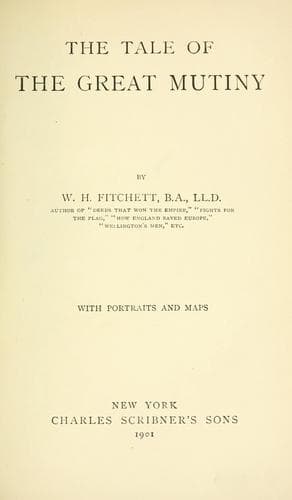
The Tale of the Great MutinyFitchett, W. H. (William Henry)
History
The Tale of the Great Mutiny
Fitchett, W. H. (William Henry)
India -- History -- Sepoy Rebellion, 1857-1858
The civilian was wiser than the soldier, and Lord Canning’s views
prevailed. But it is worth noting that Colin Campbell’s plan of “bagging”
all the mutineers with one vast, far-stretching sweep in Lucknow would
have been carried into effect on Lord Canning’s lines, but for a double
blunder, which marked Campbell’s own conduct of the siege.
It was a great task to which the British Commander-in-chief now addressed
himself. Lucknow was a huge honeycomb of native houses; a city more than
twenty miles in circumference, with a turbulent population calculated
variously at from 300,000 to 1,000,000 people. It had a garrison of
130,000 fighting men, with an overwhelming force of artillery. The Sepoy
leaders, too, who knew the value of the spade in war, had spent months in
making the city, as they believed, impregnable. Both Havelock and Colin
Campbell, in fighting their way to the Residency, had broken into the
city from the eastern front; and the Sepoys, with a touching simplicity,
took it for granted that the third attack on the city would follow the
lines of the earlier assaults. The British, that is, would cross the
canal, and force a path to the Residency through the great gardens and
stately buildings which occupied the space betwixt the mass of the city
and the Goomtee; and they accordingly barred this approach by a triple
line of formidable defences. The first was a vast flanked rampart, on the
inner side of the canal, and to which the canal served as a wet ditch.
The second was a great circular earthwork, like the curve of a railway
embankment, which enclosed the Mess-house. Behind it rose what was, in
fact, the citadel of Lucknow, the Kaisarbagh, or King’s Palace. Both
these lines stretched from the river on one flank, to the mass of houses
which constituted the town, on the other flank. They might be pierced,
they could not be turned; and they bristled from flank to flank with
heavy guns. The third line was a stupendous earthwork, covering the whole
north front of the King’s Palace. Its guns swept the narrow space betwixt
the palace and the river with their fire.
Each great building along this line of advance was itself a fortress, and
everything which ingenuity could suggest, and toil execute, had been done
to make the defence formidable. The task of fighting a way across these
triple lines, and through this tangle of fortified houses, each girdled
with rifle-pits, and loopholed from foundation to roof, might well have
been deemed impossible.
Public-domain text, read in full here on John Shaqi.
Reviews
Reviews
No reviews yet
Be the first to share your thoughts on this work.
Elsewhere in the archive
Join the Discussion
Join the discussion
Sign in to leave a comment or review.
Sign InorCreate an account