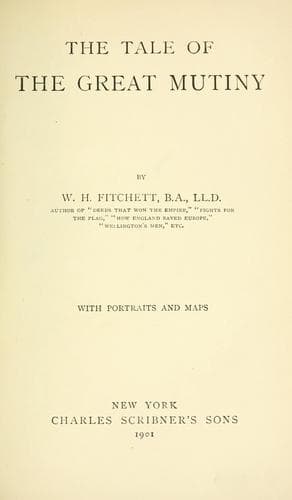
The Tale of the Great MutinyFitchett, W. H. (William Henry)
History
The Tale of the Great Mutiny
Fitchett, W. H. (William Henry)
India -- History -- Sepoy Rebellion, 1857-1858
Campbell began his operations on the morning of March 3. Forbes-Mitchell,
who stood in the ranks of the 93rd, looked out with a soldier’s eye over
the domed mosques and sky-piercing minarets of the doomed city, sharp-cut
against the morning sky. “I don’t think,” he writes, “I ever saw a
prettier scene.” Forbes-Mitchell was not an artist, only a hard-fighting
private in the 93rd; but Russell of the _Times_, who was familiar with
all the great cities of the world, was just as deeply impressed as
Forbes-Mitchell with the aspect that Lucknow wore that fateful morning,
when the red tide of war was about to fill and flood its streets. This is
how Russell describes the scene: “A vision of palaces, minarets, domes,
azure and golden, cupolas, colonnades, long façades of fair perspective,
in pillar and column, terraced roofs—all rising up amid a calm, still
ocean of the brightest verdure. Look for miles and miles away, and still
the ocean spreads, and the towers of the fairy city gleam in its midst.
Spires of gold glitter in the sun. Turrets and gilded spheres shine like
constellations. There is nothing mean or squalid to be seen. Here is a
city more vast than Paris, as it seems, and more brilliant, lying before
us.”
But there was the grim face of war hidden beneath the mask of smiling
beauty which Lucknow presented that March morning. The soldiers, as they
stood in their ranks, could see, line beyond line, the frowning Sepoy
defences; while, in the foreground, Peel, with his blue-jackets, was
getting his heavy 16-pounders into position for the fierce duel about to
begin. Colin Campbell’s movement on his left, however, was but a feint,
designed to mislead the enemy’s generals. On the night of the 4th the
construction of two bridges across the Goomtee was begun. On the morning
of the 5th one of them was completed, and the British infantry crossed,
and threw up earthworks to defend the bridge-head. By midnight on the 5th
both bridges were complete, with their approaches, and by four o’clock
the troops were crossing. Hope Grant, in command of the cavalry, covered
their front, and drove back the enemy’s horse.
The Queen’s Bays, a young regiment that had never yet been engaged, were
in the advance. They got out of hand in their ardour, and rode recklessly
on a body of Sepoy horse, smashed them with their charge, followed them
over-eagerly into broken ground, and under heavy gun-fire. They came back
broken from that wild charge, their major, Percy Smith, was killed, and
the Bays themselves suffered badly.
Public-domain text, read in full here on John Shaqi.
Reviews
Reviews
No reviews yet
Be the first to share your thoughts on this work.
Elsewhere in the archive
Join the Discussion
Join the discussion
Sign in to leave a comment or review.
Sign InorCreate an account