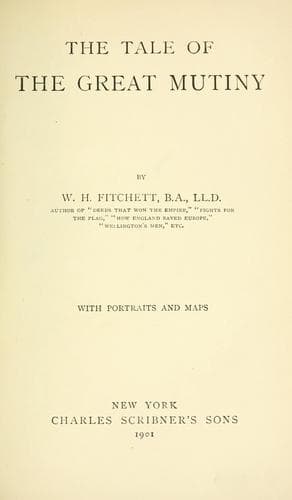
The Tale of the Great MutinyFitchett, W. H. (William Henry)
History
The Tale of the Great Mutiny
Fitchett, W. H. (William Henry)
India -- History -- Sepoy Rebellion, 1857-1858
When, before or since, has there been a contest so heroic or so hopeless?
But what can Nine do against twice as many hundreds? From the summit
of the walls a deadly fire is concentrated on the handful of gallant
British. One after another drops. In another moment will come the
rush of the bayonets. Willoughby looks round and sees Scully stooping
with lighted port-fire over the fuse, and watching for the agreed
signal. He lifts his hand. Coolly and swiftly Scully touches the fuse
with his port-fire. The red spark runs along its centre; there is an
earth-shaking crash, as of thunder, a sky-piercing leap of flame. The
walls of the magazine are torn asunder; bodies of men and fragments
of splintered arms fly aloft. The whole city seems to shake with the
concussion, and a great pillar of smoke, mushroom-topped and huge, rises
slowly in the sky. It is the signal to heaven and earth of how the Nine
British, who kept the great magazine, had fulfilled their trust.
Of those gallant Nine, Scully, who fired the train, and four others
vanished, along with hundreds of the mutineers, in one red rain. But,
somehow, they themselves scarcely knew how, Willoughby, with his two
officers, and Conductor Buckley found themselves, smoke-blackened and
dazed, outside the magazine, and they escaped death, for the moment at
least.
The fugitives who escaped from the Cashmere Gate had some very tragical
experiences. Sinking from fatigue and hunger, scorched by the flame-like
heat of the sun, wading rivers, toiling through jungles, hunted by
villagers, they struggled on, seeking some place of refuge. Some reached
Meerut, others Umballa, but many died. Of that much-enduring company of
fugitives, it is recorded that the women often showed the highest degree
of fortitude and patience. Yet more than one mother had to lay her child,
killed by mere exposure or heat, in a nameless jungle grave; more than
one wife had to see her husband die, of bullet or sword-stroke, at her
feet.
But the fate of these wanderers was happier than that of the Europeans
left in the city. Some twenty-seven—eleven of them being children and
eight women—took refuge in a house near the great mosque. They held the
house for three days, but, having no water, suffered all the agonies of
thirst. The Sepoys set vessels of water in front of the house, and bade
the poor besieged give up their arms and they should drink. They yielded,
gave up the two miserable guns with which they had defended themselves,
and were led out. No water was given them. Death alone was to cool those
fever-blackened lips. They were set in a row, the eleven children and
sixteen men and women, and shot. Let tender-hearted mothers picture that
scene, transacted under the white glare of the Indian sun!
Public-domain text, read in full here on John Shaqi.
Reviews
Reviews
No reviews yet
Be the first to share your thoughts on this work.
Join the Discussion
Join the discussion
Sign in to leave a comment or review.
Sign InorCreate an account