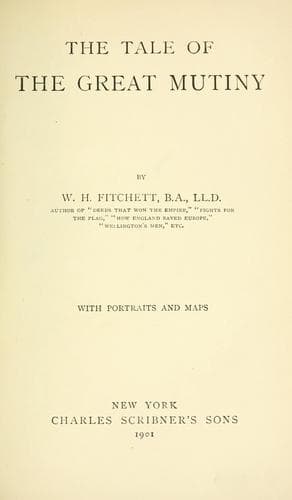
The Tale of the Great MutinyFitchett, W. H. (William Henry)
History
The Tale of the Great Mutiny
Fitchett, W. H. (William Henry)
India -- History -- Sepoy Rebellion, 1857-1858
Havelock’s men had marched nineteen miles, and fought and won a great
battle, without a particle of food, and so dreadful was the heat that
twelve men died of sunstroke. Havelock camped on July 13 to give his
men rest, resumed his march on the 14th, and on the morning of the
15th found the Sepoys drawn up in great strength in front of a village
called Aong, twenty-two miles south of Cawnpore. Renaud led his Fusileers
straight at the village, and carried it with a furious bayonet charge,
but the gallant leader of the “blue caps” fell, mortally wounded, in
the charge. Maude’s guns smashed the enemy’s artillery, and when the
Highlanders and the 64th were seen coming on, the Sepoys again fled.
Havelock pressed steadily on, and found the Sepoys had rallied and were
drawn up in a strong position, covered by a rivulet, swollen bank-high
with recent rains, known as Pandoo Nuddee. A fine stone bridge crossed
the river; it was guarded by a 24-pound gun, a 25-pound carronade, and a
strong force of infantry. Havelock quickly developed his plan of attack.
Maude raced forward with his guns, and placed them at three different
points, so as to bring a concentric fire to bear on the bridge. Maude’s
first blast of spherical case-shell broke the sponge staves of the heavy
guns in the rebel battery, and rendered them useless.
The Sepoys tried to blow up the bridge. But Maude’s fire was hot;
Stephenson, with his “blue caps,” was coming up at the double, and the
Sepoys got flurried. They had mined the bridge, and the mine was fired
prematurely. The explosion shattered the parapet of the bridge, but
through the white smoke came the Fusileers, their bayonets sparkling
vengefully. The Highlanders followed eagerly in support. The bridge was
carried, the guns taken, the rebel gunners bayoneted, the rebel centre
pierced and broken, and the rebel army itself swept northwards, with
infinite dust and noise, in a mere tumult of panic-stricken flight.
The British camped for the night on the battlefield. At three o’clock in
the morning, with the stars sparkling keenly over their heads, and a full
moon flooding the camp with its white light, Havelock formed up his men.
He told them he had learned there were some 200 women and children still
held as prisoners in Cawnpore, the survivors of the massacre of June 27.
“Think of our women and the little ones,” he said, “in the power of those
devils incarnate.” The men answered with a shout, and, without waiting
for the word of command, went “fours right,” and took the road.
Public-domain text, read in full here on John Shaqi.
Reviews
Reviews
No reviews yet
Be the first to share your thoughts on this work.
Elsewhere in the archive
Join the Discussion
Join the discussion
Sign in to leave a comment or review.
Sign InorCreate an account