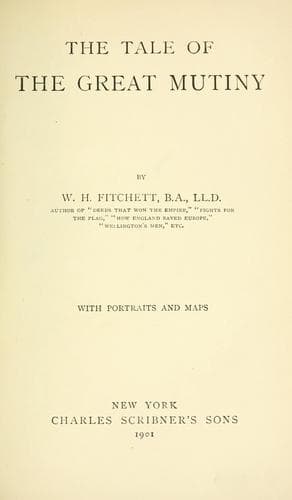
The Tale of the Great MutinyFitchett, W. H. (William Henry)
History
The Tale of the Great Mutiny
Fitchett, W. H. (William Henry)
India -- History -- Sepoy Rebellion, 1857-1858
It was a march of twenty miles. The sun rose and scorched the silent and
panting ranks of the British with its pitiless heat. The Highlanders
suffered most; they were wholly unprepared for a summer campaign, and
were actually wearing the heavy woollen doublets intended for winter use;
but their stubborn Northern blood sustained them. Every now and again,
indeed, some poor fellow in the ranks dropped as though shot through
the head, literally killed with the heat. Nana Sahib himself held the
approach to Cawnpore, with 7000 troops and a powerful artillery, and his
position was found to be of great strength.
Havelock studied it a few minutes with keen and soldierly glance, and
formed his plans. He had the genius which can use rules, but which also,
on occasion, can dispense with rules. He violated all the accepted canons
of war in his attack upon the Nana’s position. He amused the enemy’s
front with the fire of a company of the Fusileers, and the manœuvres of
Barrow’s twenty volunteer sabres, while with his whole force he himself
swept round to the right to turn the Nana’s flank. Havelock, that is,
risked his baggage and his communications, to strike a daring blow for
victory.
As Havelock’s men pressed grimly forward, screened by a small grove,
they heard the bands of the Sepoy regiments playing “Auld lang syne” and
“Cheer, boys, cheer,” and the sound made the men clutch their muskets
with a little touch of added fury. The Sepoys discovered Havelock’s
strategy rather late, and swung their guns round to meet it. Their fire
smote the flank of Havelock’s column cruelly, but the British never
paused nor faltered. When Havelock judged his turning movement was
sufficiently advanced, he wheeled the column into line. His light guns
were insufficient to beat down the fire of the heavy pieces worked by the
rebels, and he launched his Highlanders at the battery. They moved dourly
forward under a heavy fire, till within eighty yards of the guns. Then
the bayonets came down to the charge, and with heads bent low and kilts
flying in the wind, the Highlanders went in with a run. The charge was
in perfect silence, not a shot nor a shout being heard; but it was so
furious that mound and guns were carried in an instant, and the village
itself swept through. As Forbes describes it, “Mad with the ardour of
battle, every drop of Highland blood afire in every vein, the Ross-shire
men crashed right through the village, and cleared it before they dropped
out of the double.” They had crushed the enemy’s left, taken its guns,
and sent a great mass of Sepoys whirling to the rear.
Public-domain text, read in full here on John Shaqi.
Reviews
Reviews
No reviews yet
Be the first to share your thoughts on this work.
Elsewhere in the archive
Join the Discussion
Join the discussion
Sign in to leave a comment or review.
Sign InorCreate an account