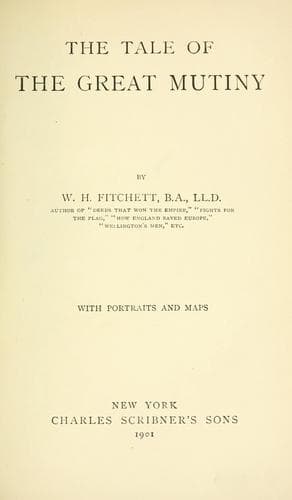
The Tale of the Great MutinyFitchett, W. H. (William Henry)
History
The Tale of the Great Mutiny
Fitchett, W. H. (William Henry)
India -- History -- Sepoy Rebellion, 1857-1858
The left battalion was the 64th. Major Stirling promptly brought forward
his leading files, and Havelock’s son and aide-de-camp galloped down,
and, riding beside Stirling, shared with him the leadership of the
charge—a circumstance for which the 64th, as a matter of fact, scarcely
forgave him, as they wanted no better leadership than that of their own
major. There was less of _élan_ and dash about this charge than in the
earlier charges of the day; but in steady valour it was unsurpassed.
On came the 64th, silently and coolly. Havelock himself, in a letter to
his wife, wrote with a father’s pride about his son. “I never saw so
brave a youth,” he wrote, “as the boy Harry: he placed himself opposite
the muzzle of a gun that was scattering death into the ranks of the 64th
Queen’s, and led on the regiment under a shower of grape to its capture.
This finished the fight. The grape was deadly, but he calm, as if telling
George stories about India.”
When the steady but shot-tormented line of the 64th found itself so near
the battery that through the whirling smoke they could see the toiling
gunners and the gleam of Sepoy bayonets beyond them, then the British
soldiers made their leap. With a shout they charged on and over the guns,
and through the lines behind, and Nana Sahib’s force was utterly and
finally crushed. Havelock had not a sabre to launch on the flying foe;
but his tired infantry, who had marched twenty miles, and fought without
pause for four hours, kept up the pursuit till the outer edge of Cawnpore
was reached. Then Havelock halted them; and, piling arms, the exhausted
soldiers dropped in sections where they stood, falling asleep on the bare
ground, careless of food or tents.
They were aroused long before daybreak, and through their ranks ran in
whispers the story, grim and terrible, of the massacre which, by only a
few hours, had cheated their splendid valour of its reward.
How great was the valour, how stubborn the endurance, shown thus far
by Havelock’s men is not easily realised. In nine days—betwixt July
7-16—they had, to quote their commander’s words “marched under the Indian
sun of July 126 miles, and fought four actions.” What better proof of
hardihood, valour, and discipline could be imagined? But the British
soldier is a queer compound, with very sudden and surprising alternations
of virtue. When Cawnpore was won and plundered, immense stores of beer
and spirits fell into the hands of the soldiers, and for a time it seemed
as if Havelock’s band of heroes would dissolve into a mere ignoble gang
of drunkards. Havelock promptly ordered every drinkable thing in Cawnpore
to be bought or seized. “If I had not done this,” he wrote, “it would
have required one half my force to keep the other half sober, and I
should not have had a soldier in camp!”
Public-domain text, read in full here on John Shaqi.
Reviews
Reviews
No reviews yet
Be the first to share your thoughts on this work.
Elsewhere in the archive
Join the Discussion
Join the discussion
Sign in to leave a comment or review.
Sign InorCreate an account