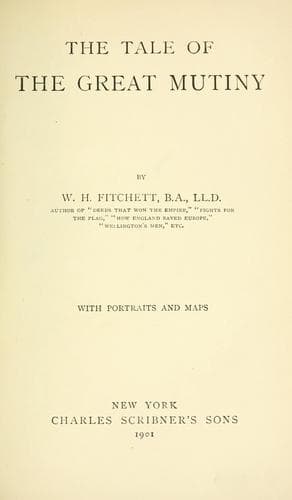
The Tale of the Great MutinyFitchett, W. H. (William Henry)
History
The Tale of the Great Mutiny
Fitchett, W. H. (William Henry)
India -- History -- Sepoy Rebellion, 1857-1858
Whether the terror of Havelock’s advance on Cawnpore actually caused
the massacre of the English captives there may be doubted; it certainly
hastened it. Nana Sahib, to whom murder was a luxury, would no more have
spared the women and the children than a tiger would spare a lamb lying
under its paw. But even a tiger has its lazy moods, and, say, immediately
after a full meal, is temporarily careless about fresh slaughter. Nana
Sahib had supped full of cruelty, and was disposed, for a brief period at
all events, to allow his captives to live. Moreover, some of the women
in his own harem sent him word they would slay themselves and their
children if he murdered the memsahibs and their little ones. But on the
night of July 15 the fugitives from Pandoo Nuddee reached Cawnpore,
amongst them being Bala Rao, the Nana’s brother and general, who brought
from the fight a bullet in his shoulder, and a new argument for murder in
his heart.
In a council held between the Nana and his chief officials that night,
the fate of the captives was discussed. Teeka Sing understood British
nature so ill that he argued Havelock’s men would be robbed of their only
motive for continuing their advance on Cawnpore if the captives were
slain. They might, he urged, risk the perils of a new battle for the sake
of rescuing the captives, but not for the mere pleasure of burying them.
That they might have the passion to avenge them did not enter into Teeka
Sing’s somewhat limited intelligence. Other chiefs argued, again, that
if the captives were allowed to live, they might prove very inconvenient
witnesses against a good many people.
It is probable that the strongest argument on the side of murder was the
mere joy of killing somebody with a white face. Havelock’s Fusileers and
Highlanders declined to allow themselves to be killed; they were, in
fact, slaying the Nana’s Sepoys with disconcerting fury and despatch. But
the heroes who had fled again and again before a British force one-fifth
their number, could revenge themselves in perfect security by slaying the
helpless women and children imprisoned in the Bebeeghur. So the order for
massacre went forth.
Public-domain text, read in full here on John Shaqi.
Reviews
Reviews
No reviews yet
Be the first to share your thoughts on this work.
Elsewhere in the archive
Join the Discussion
Join the discussion
Sign in to leave a comment or review.
Sign InorCreate an account