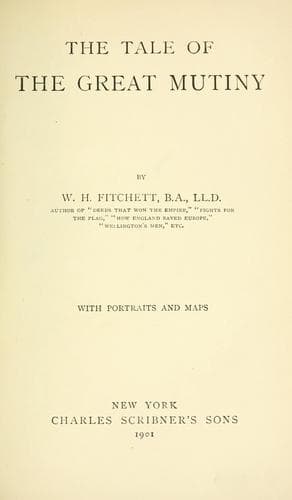
The Tale of the Great MutinyFitchett, W. H. (William Henry)
History
The Tale of the Great Mutiny
Fitchett, W. H. (William Henry)
India -- History -- Sepoy Rebellion, 1857-1858
When Havelock’s men afterwards entered those rooms, one little detail
bore mute witness to the use to which some of the ladies had turned the
few minutes which followed the volley of the Sepoys. They evidently tore
strips from their dresses, and with them tried to tie the door fast; and
still those broken strips of linen and silk were hanging from the door
handles when Havelock’s men, two days afterwards, entered Cawnpore.
Crime never wants instruments, and Nana Sahib soon found scoundrels
willing to carry out his orders. It was a little after five o’clock—just
when Stephenson’s Fusileers and Hamilton’s Highlanders were sweeping over
the bridge at Pandoo Nuddee—that five men, each carrying a tulwar, walked
to the door of the Bebeeghur. Two were rough peasants; two belonged to
the butcher’s caste; one wore the red uniform of the Nana’s bodyguard.
The five men entered, and the shuddering crowd of women and children was
before them. The crowd, who watched as the door opened, saw standing
erect on the threshold the English lady who had asked the native officer
whether they were all to be killed. Then the door was closed, and over
the scene that followed the horrified imagination refuses to linger.
Wailing, broken shrieks, the sound of running feet crept out on the
shuddering air. Presently the door opened, and the man in the red uniform
of the Nana’s bodyguard came out with his sword broken short off at the
hilt. There were 212 to be killed, and the strain on steel blades as well
as on human muscles was severe!
He borrowed a fresh sword, and went back to his work, again carefully
closing the door behind him. After a while he re-emerged once more with
a broken blade, and, arming himself afresh, returned a third time to
his dreadful business. It was dark when the five men—all alike now with
reddened garments—came out and locked the door behind them, leaving
that great company of wives and mothers and little children in the
slaughter-house. The men had done their work but roughly, and all through
the night, though no cry was heard in the Bebeeghur, yet sounds, as if
sighs from dying lips, and the rustle as of struggling bodies, seemed to
creep out into the darkness incessantly through its sullen windows and
hard-shut doors.
At eight o’clock the next morning the five men returned, attended by a
few sweepers. They opened the door, and commenced to drag the nearer
bodies, by their long tresses of hair, across the courtyard to the fatal
well, hard by. Then, amongst the bodies lying prone over all the floor,
there was a sudden stir of living things. Were the dead coming back to
life?
Public-domain text, read in full here on John Shaqi.
Reviews
Reviews
No reviews yet
Be the first to share your thoughts on this work.
Elsewhere in the archive
Join the Discussion
Join the discussion
Sign in to leave a comment or review.
Sign InorCreate an account