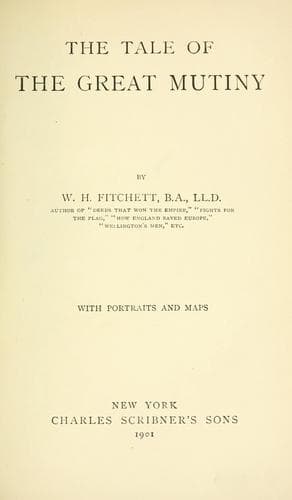
The Tale of the Great MutinyFitchett, W. H. (William Henry)
History
The Tale of the Great Mutiny
Fitchett, W. H. (William Henry)
India -- History -- Sepoy Rebellion, 1857-1858
Native evidence, collected afterwards, reports that a few children and
nearly a dozen women had contrived to escape death by hiding under the
bodies of the slain. They had lain in that dreadful concealment all
night, but when the five returned they crept out with pitiful cries. Some
of these were slain without parley; some ran like hunted animals round
the courtyard, and then threw themselves down the well. One by one the
victims were dragged out, stripped, and, many of them yet living, were
flung into that dreadful grave.
One native witness, quoted by Trevelyan, says, “There was a great crowd
looking on; they were standing along the walls of the compound. They
were principally city people and villagers. Yes, there were also Sepoys.
Three boys were alive. They were fair children. The eldest, I think, must
have been six or seven, and the youngest five years. They were running
round the well (where else could they go to?), and there was none to save
them. No, none said a word, or tried to save them.” The youngest of these
children, a tender little fellow, lunatic with terror, broke loose and
ran like a hare across the courtyard. He was captured by an unsympathetic
spectator, brought back, and flung down the well.
It was two days after this, on July 17, that three men of the 78th
entered the court, for Havelock was now in possession of Cawnpore, and
the Nana was a fugitive. The whispers and gestures of the natives drew
their attention to the shut door of the bungalow. One of the Highlanders
pushed open the door and stepped inside. “The next moment,” to quote
Archibald Forbes, “he came rushing out, his face ghastly, his hands
working convulsively, his whole aspect, as he strove in vain to gasp out
some articulate sounds, showing that he had seen some dreadful sight.” No
living thing was in the place; but the matting that covered the floor was
one great sponge of blood, and he who had crossed it found himself, to
borrow Burns’s phrase, “red wat shod.”
Little pools of blood filled up each inequality in the rough floor.
It was strewn with pitiful relics, broken combs, pinafores, children’s
shoes, little hats, the leaves of books, fragments of letters. The
plastered wall was hacked with sword-cuts, “not high up, as where men had
fought, but low down and about the corners, as if a creature had crouched
to avoid a blow.” Long locks of hair were strewn about, severed, but not
with scissors.
There were no inscriptions on the walls, but many a pitiful record
upon the scattered papers on the floor. A few childish curls marked
“Ned’s hair, with love;” the fly-leaf of a Bible, with a loving
inscription—giver and recipient now both dead; a prayer-book, pages
splashed red where once praying eyes had lingered. The pages of one
grimly appropriate book—Drelincourt’s “Preparation for Death”—were
scattered over the whole floor.
* * * * *
Public-domain text, read in full here on John Shaqi.
Reviews
Reviews
No reviews yet
Be the first to share your thoughts on this work.
Elsewhere in the archive
Join the Discussion
Join the discussion
Sign in to leave a comment or review.
Sign InorCreate an account