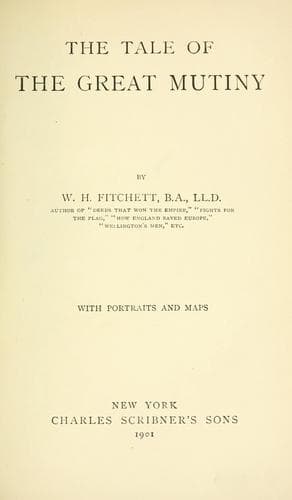
The Tale of the Great MutinyFitchett, W. H. (William Henry)
History
The Tale of the Great Mutiny
Fitchett, W. H. (William Henry)
India -- History -- Sepoy Rebellion, 1857-1858
There is no space to tell here in detail the tale of the noble courage
and energy with which Lawrence kept the seething and turbulent city from
revolt through May and June. The mere garrison figures of Lucknow show
Lawrence’s position. He had 700 Europeans on whom he could rely. There
were 7000 Sepoys, all potential, and highly probable mutineers. Beyond
this was a great turbulent and fanatical city, with a population of, say,
700,000, a magazine waiting to explode at the touch of a match.
The peril was certain in its character, but was uncertain in scale,
and time, and form. Lawrence had to arm himself against that vague,
formless, yet terrific peril, without letting those who watched him
closely and keenly discover that he was conscious of its existence. He
had to hide an anxious brain behind a cheerful face; to prepare minutely
for swift-coming and desperate war, while wearing the dress, and talking
the language of peace; to turn a hospitable Residency into a fortress;
and yet keep open doors and an open table. And he did it all! When, the
morning after Chinhut, the Residency was closely and furiously besieged,
it was found to be provisioned, organised, and armed for a stern and
obstinate and, in the end, successful defence!
Lawrence read the whole position of affairs so truly that his forecast
of events has in it a gleam of something like prophecy, or of magic. “He
told me,” says Colonel Wilson, “that nearly the whole army would go, but
not, he thought, the Sikhs; that in every native regiment there was a
residuum of loyal Sepoys, and he meant, if possible, to retain these—as
he actually did. If Cawnpore held out, Lucknow would be unassailed; but
if Cawnpore fell, Lucknow would be hard pressed, and no succour could
reach the city before the middle of August; that the outbreak would
remain a revolt of the Sepoys, and not a rising of the people.”
Public-domain text, read in full here on John Shaqi.
Reviews
Reviews
No reviews yet
Be the first to share your thoughts on this work.
Elsewhere in the archive
Join the Discussion
Join the discussion
Sign in to leave a comment or review.
Sign InorCreate an account