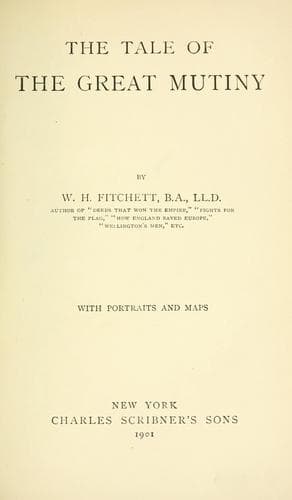
The Tale of the Great MutinyFitchett, W. H. (William Henry)
History
The Tale of the Great Mutiny
Fitchett, W. H. (William Henry)
India -- History -- Sepoy Rebellion, 1857-1858
Lawrence’s own policy, meanwhile, was to fight for time. Every hour the
Mutiny could be postponed lessened its chances of success. “Time,” he
writes in his diary on May 18, “is everything just now; time, firmness,
promptness, conciliation, prudence.” But Lawrence had many difficulties
in carrying out that wise policy, some of them created by the divided
judgments of his own staff. Mr. Gubbins, the financial commissioner, in
particular, vehemently mistrusted Lawrence’s mild handling of the Sepoys.
Gubbins was clever, audacious, quick-witted, fatally over-quick, perhaps,
in judgment, with a gift for giving advice in confident—not to say
imperious—accents, which his official superiors found somewhat trying.
He valued his own advice, too, so highly that he could not forgive the
dulness in his superiors which failed to discern its excellence, or the
hesitation which lingered in putting it into practice. He was perpetually
urging Lawrence to disarm and expel all the native troops in Lucknow.
Yet Lawrence’s milder policy was justified by events. Some seven hundred
Sepoys remained true to their salt, and served through the great siege
with a devotion and a courage beyond praise. “Neither temptation nor
threats from their comrades without,” says Fayrer, “or hardships and
privation within, could induce them to desert. There is nothing in the
history of the Sepoy army more creditable or honourable than their
behaviour.”
Lawrence had other troubles with the Europeans in Lucknow. An indiscreet
editor in Lucknow published some alarmist articles of a singularly
mischievous character, and Lawrence sent for him, and warned him that,
if he continued to write in a fashion calculated to provoke mutiny, he
would suppress his paper. But Lawrence knew human nature too well to
believe that mere threats would keep a foolish editor from committing
folly. A few days afterwards, happening to ride by the newspaper office,
he suddenly drew rein, and said to his staff, “Let us go in and edit the
paper for Mr. ⸺.” He entered, said to the astonished editor, “Mr. ⸺, to
show you I bear no ill-will, I am come to write you a leading article;”
and, sitting down, dashed off an article expounding the resources of the
Government for meeting and putting down a revolt. The article acted as a
tonic on native and European opinion in the city; but it also captured
the editor.
Public-domain text, read in full here on John Shaqi.
Reviews
Reviews
No reviews yet
Be the first to share your thoughts on this work.
Elsewhere in the archive
Join the Discussion
Join the discussion
Sign in to leave a comment or review.
Sign InorCreate an account