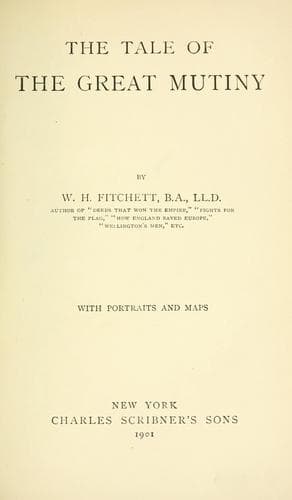
The Tale of the Great MutinyFitchett, W. H. (William Henry)
History
The Tale of the Great Mutiny
Fitchett, W. H. (William Henry)
India -- History -- Sepoy Rebellion, 1857-1858
Lawrence had not a very keen sense of humour, but occasionally humour—of
a grim sort—broke out from him. A Hindu of some rank advised that a
number of monkeys should be collected in the Residency, and be attended
and fed by high-caste Brahmins. This would ensure the favour of all
the Hindu divinities, and would make the English popular. Lawrence
listened gravely, then said, “Your advice is good. Come,” he said,
rising and taking his hat, “I will show you my monkeys.” He led the way
to a battery which had just been completed; and laying his hand on an
18-pounder gun, said, “See! here is one of my monkeys. That”—pointing to
a pile of shot—“is his food, and this”—laying his hand on the shoulder
of a sentry of the 32nd, who stood at attention close by—“is the man who
feeds them. Now go and tell your friends of my monkeys!”
The serene quality of Lawrence’s courage is shown by a letter he
writes to Raikes on May 30: “We are pretty jolly ... but we are in
a funny position.... We are virtually besieging four regiments—in a
quiet way—with 300 Europeans. I ... reside in cantonments guarded by
the gentlemen we are besieging.” That very night, as it happened, the
outbreak came!
On the last day of June the disastrous fight at Chinhut brought affairs
at Lucknow to a crisis. The revolted regiments from Eastern Oude were
marching on Lucknow, and Lawrence, acting on the one principle of British
war in India—of striking and never waiting to be struck—marched out to
crush the approaching mutinous regiments. His little force consisted of
300 of the 32nd, 230 more or less loyal Sepoys, 36 British volunteers
on horseback, 120 native cavalry, and 10 guns, of which six were manned
by Sepoys. There was grave doubt as to how the native artillery would
behave; but Lawrence said, “We must try and ‘blood’ them.”
As it happened, Lawrence was completely deceived as to the strength of
the enemy. He reckoned they might number 5000; they were nearer 15,000,
with not less than thirty guns. By some accident, too, the 32nd were
marched out without having broken their fast, and, marching eight miles
under the glare of an Indian sun, were exhausted before they fired a shot.
Public-domain text, read in full here on John Shaqi.
Reviews
Reviews
No reviews yet
Be the first to share your thoughts on this work.
Elsewhere in the archive
Join the Discussion
Join the discussion
Sign in to leave a comment or review.
Sign InorCreate an account