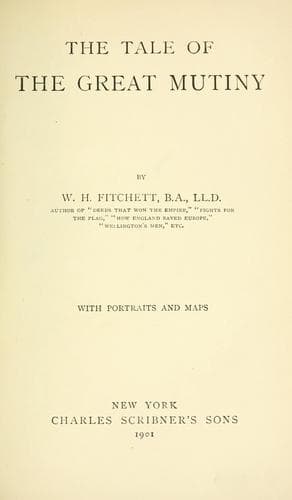
The Tale of the Great MutinyFitchett, W. H. (William Henry)
History
The Tale of the Great Mutiny
Fitchett, W. H. (William Henry)
India -- History -- Sepoy Rebellion, 1857-1858
composure fail, and he wept those rare, reluctant tears which strong men
know. He wished to partake of the Sacrament of the Lord’s Supper. The
service was held in the open verandah, the sound of the chaplain’s voice
being broken by the incessant crackle of hostile muskets and the crash of
cannon-ball. Brave men knelt with unshamed tears by Lawrence’s bedside,
and partook of the Sacrament with him.
After it was over the dying man begged them to kiss him. The whole story,
indeed, recalls that scene in the cockpit of the _Victory_, and the dying
Nelson’s “Kiss me, Hardy!” “Bury me,” said Lawrence, “without any fuss,
and in the same grave with any men of the garrison who may die at that
time.” Then, records his biographer, “speaking rather to himself than to
those about him,” he framed his own immortal epitaph, a sentence which
deserves to be remembered as long as Nelson’s great signal itself, and
which, indeed, has the same key-word: “Here lies Henry Lawrence, who
tried to do his duty. May God have mercy on him.” It is not so well known
that Lawrence wished a verse of Scripture should be added to his epitaph.
To the chaplain, Harris, he said, “This text I should like, ‘To the Lord
our God belong mercies and forgivenesses, though we have rebelled against
Him.’” “It was,” he added, with a sudden touch of loving memory, “on my
dear wife’s tomb.”
He was buried at nightfall. The combat was raging fiercely along each
front of the Residency’s defences, and not an officer could follow the
general to his grave. Four men of the 32nd were detailed to carry his
body to its last rough resting-place. Before they lifted the couch on
which it lay, one soldier drew down the sheet, and stooping, kissed with
rough and quivering lips the dead man’s forehead, and each man of the
party followed his example. What better sign of soldierly honour could be
imagined? Lawrence’s burial curiously recalls that of Sir John Moore at
Corunna. He, too, was buried, according to somewhat inaccurate tradition,
“darkly, at the dead of night,” and had for his requiem the thunder of
the foeman’s guns.
The story of the siege is, in the main, one of personal combats; of the
duels of hostile sharpshooters; of desperate fighting underground in
the mines; of sorties by the few against the many; of the assaults of
thousands repulsed by scores. As a type of the long-enduring courage with
which individual “posts” were held may be taken the single fact that
Captain Anderson, whose residence formed what was called “Anderson’s
post,” and who had a garrison of only twenty men, held his position for
five months, though a battery of nine 9-pounder guns was playing upon it
almost day and night!
Public-domain text, read in full here on John Shaqi.
Reviews
Reviews
No reviews yet
Be the first to share your thoughts on this work.
Elsewhere in the archive
Join the Discussion
Join the discussion
Sign in to leave a comment or review.
Sign InorCreate an account