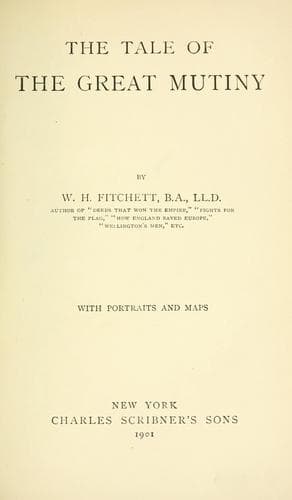
The Tale of the Great MutinyFitchett, W. H. (William Henry)
History
The Tale of the Great Mutiny
Fitchett, W. H. (William Henry)
India -- History -- Sepoy Rebellion, 1857-1858
The standing orders were, “Keep under cover, be always on the alert,
and never fire a shot unless you can see your man.” But it was very
difficult to enforce the first clause of those instructions, at least.
Lady Inglis tells how she once personally remonstrated with a too daring
private of the 32nd for exposing himself too rashly, and reminded him of
the “instructions.” “Yes,” he said, “but it’s not the way of Englishmen
to fight behind walls!”
As a matter of fact, the sorties were incessant and most daring, and were
commonly got up by small independent parties, who wished to clear out a
house held by the enemy, or silence a gun that proved too tormenting.
“The local sorties,” says Innes, “were made generally by parties of not
more than half-a-dozen men.” They would choose their own leader, creep
out close to the site of some hostile gun or picket, dash on it, spike
the gun, kill a few of the enemy, send the others flying, and return in
triumph!
In the more regular sorties an engineer officer and a sergeant leading
would run out, carrying a bag of gunpowder or a couple of hand grenades.
If the door of the attacked house was open, grenades were thrown in. If
it were shut they drove in a bayonet, or screwed a gimlet in its wood,
suspended a bag of powder to it, and lit the fuse. The moment the crash
came the stormers charged into the building, bayoneted the Sepoys holding
it, placed another bag of gunpowder on the floor, lit the fuse, and fell
back, the house five minutes afterwards flying up in fragments into
the air. So expert did the men become in these house attacks that they
learned the art of always going to the right, not the left, of a doorway
or passage, so that they could fire into it without exposing the whole
body.
This sort of fighting naturally brought the more gallant spirits to the
front. A private of the 32nd, called Cooney, played a great part in these
independent combats. With a single comrade he charged into an enemy’s
battery, shouting, as he leaped over the ridge of earth, “Right and left,
extend!” so that the Sepoys imagined a strong body was following, and
fled precipitately, leaving the ingenious Cooney and his comrade to spike
the guns at leisure!
Captain Birch says: “Cooney’s exploits were marvellous. He was backed by
a Sepoy named Kandiel, who simply adored him. Single-handed, and without
any orders, Cooney would go outside our position, and he knew more about
the enemy’s movements than anybody else. Over and over again he was put
into the guard-room for ‘disobedience of orders,’ and as often let out
when there was fighting to be done. On one occasion, he surprised one of
the enemy’s batteries into which he crawled, followed by his faithful
Sepoy, bayoneting four men, and spiking the guns. He was often wounded,
and several times left his bed to volunteer for a sortie.” Cooney was an
Irishman, and loved fighting for its own sake. He fell in a sortie made
after Havelock’s relief.
Public-domain text, read in full here on John Shaqi.
Reviews
Reviews
No reviews yet
Be the first to share your thoughts on this work.
Elsewhere in the archive
Join the Discussion
Join the discussion
Sign in to leave a comment or review.
Sign InorCreate an account