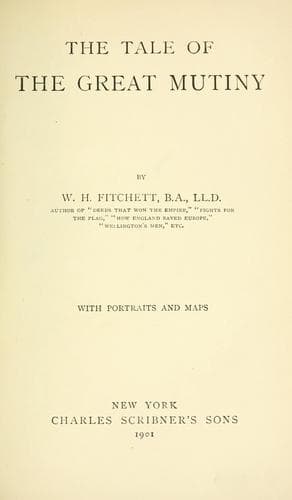
The Tale of the Great MutinyFitchett, W. H. (William Henry)
History
The Tale of the Great Mutiny
Fitchett, W. H. (William Henry)
India -- History -- Sepoy Rebellion, 1857-1858
Fayrer, the Residency surgeon, combined with equal energy the somewhat
contradictory duties of inflicting wounds and of healing them. He worked
with tireless energy, attending to the sick and wounded in the Residency
itself. But he records, “I have constant opportunity of using my guns and
rifles from the roof of my house, or from the platform in front of it.”
And when this indefatigable doctor was not going his round among the sick
and dying, he was to be found on his house-roof bringing down Sepoys with
the deadly skill he had learned in the jungle against tigers and deer.
The best shot on the British side was Lieutenant Sewell, who, happy in
the possession of a double-barrelled Enfield rifle, from a loophole on
the top of the brigade mess, which commanded a thoroughfare through the
Sepoy position, bagged his men as a good sportsman might bag pheasants
in a crowded cover. But the Sepoys, too, had their marksmen, whose
accuracy was deadly, and whose exploits won from the British garrison the
nicknames of “Jim the Rifleman” and “Bob the Nailer.” “Bob the Nailer,”
from his perch high up in what was called Johannes’ house, wrought deadly
mischief. The British at last paid him the compliment of levelling a
howitzer at him, and dropping a shell into his eyrie. But shells were
vain. It was discovered afterwards that “Bob the Nailer,” when he saw
that the gun was about to fire, dropped down into a sheltered room, to
emerge, as soon as the shell had exploded, with his fatal rifle once more.
Once a dash was made at Johannes’ house, and its garrison slaughtered,
but “Bob the Nailer” escaped, and there was not time to blow up the
house. Later in the siege a mine was run under his perch, and Johannes’
house, crowded with Sepoys, with “Bob the Nailer” at its summit, was
blown into space.
There were moments in the siege when, naturally, the spirits of many
in the garrison sank. The children were dying from want of air, of
exercise, of wholesome food. They shrank into mere wizen-faced old
men—tiny skeletons with tightened, parchment-like skin, instead of
round, cherub-like faces. Scurvy tainted the blood of the unfortunate
garrison. Sleeplessness and the ever-present atmosphere of danger
shook their nerves. Men stole out day after day, at the risk of their
lives, to gather the leaves of a cruciferous plant, whose green leaves,
unscorched by the flame of powder, could be seen amongst the ruins. A
rank and dreadful stench of decaying bodies hung over the shot-tormented
Residency, and poisoned the very air. Lady Inglis tells how the ladies
held rueful debate among themselves as to the lawfulness of taking their
own lives if the Residency fell.
Public-domain text, read in full here on John Shaqi.
Reviews
Reviews
No reviews yet
Be the first to share your thoughts on this work.
Elsewhere in the archive
Join the Discussion
Join the discussion
Sign in to leave a comment or review.
Sign InorCreate an account