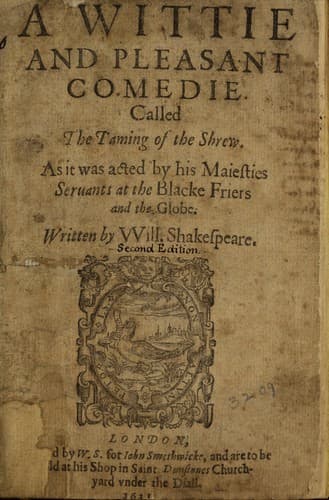
Comedy plays; Man-woman relationships -- Drama; Married people -- Drama; Padua (Italy) -- Drama; Sex role -- Drama
TAILOR.
‘With a trunk sleeve.’
GRUMIO.
I confess two sleeves.
TAILOR.
‘The sleeves curiously cut.’
PETRUCHIO.
Ay, there’s the villainy.
GRUMIO.
Error i’ the bill, sir; error i’ the bill. I commanded the sleeves
should be cut out, and sew’d up again; and that I’ll prove upon thee,
though thy little finger be armed in a thimble.
TAILOR.
This is true that I say; and I had thee in place where thou shouldst
know it.
GRUMIO.
I am for thee straight; take thou the bill, give me thy mete-yard, and
spare not me.
HORTENSIO.
God-a-mercy, Grumio! Then he shall have no odds.
PETRUCHIO.
Well, sir, in brief, the gown is not for me.
GRUMIO.
You are i’ the right, sir; ’tis for my mistress.
PETRUCHIO.
Go, take it up unto thy master’s use.
GRUMIO.
Villain, not for thy life! Take up my mistress’ gown for thy master’s
use!
PETRUCHIO.
Why, sir, what’s your conceit in that?
GRUMIO.
O, sir, the conceit is deeper than you think for.
Take up my mistress’ gown to his master’s use!
O fie, fie, fie!
PETRUCHIO.
[_Aside_] Hortensio, say thou wilt see the tailor paid.
[_To Tailor._] Go take it hence; be gone, and say no more.
HORTENSIO.
[_Aside to Tailor._] Tailor, I’ll pay thee for thy gown tomorrow;
Take no unkindness of his hasty words.
Away, I say! commend me to thy master.
[_Exit Tailor._]
PETRUCHIO.
Well, come, my Kate; we will unto your father’s
Even in these honest mean habiliments.
Our purses shall be proud, our garments poor
For ’tis the mind that makes the body rich;
And as the sun breaks through the darkest clouds,
So honour peereth in the meanest habit.
What, is the jay more precious than the lark
Because his feathers are more beautiful?
Or is the adder better than the eel
Because his painted skin contents the eye?
O no, good Kate; neither art thou the worse
For this poor furniture and mean array.
If thou account’st it shame, lay it on me;
And therefore frolic; we will hence forthwith,
To feast and sport us at thy father’s house.
Go call my men, and let us straight to him;
And bring our horses unto Long-lane end;
There will we mount, and thither walk on foot.
Let’s see; I think ’tis now some seven o’clock,
And well we may come there by dinner-time.
KATHERINA.
I dare assure you, sir, ’tis almost two,
And ’twill be supper-time ere you come there.
PETRUCHIO.
It shall be seven ere I go to horse.
Look what I speak, or do, or think to do,
You are still crossing it. Sirs, let ’t alone:
I will not go today; and ere I do,
It shall be what o’clock I say it is.
HORTENSIO.
Why, so this gallant will command the sun.
[_Exeunt._]
SCENE IV. Padua. Before Baptista’s house.
Enter Tranio and the Pedant dressed like Vincentio
TRANIO.
Sir, this is the house; please it you that I call?
PEDANT.
Ay, what else? and, but I be deceived,
Signior Baptista may remember me,
Near twenty years ago in Genoa,
Where we were lodgers at the Pegasus.
TRANIO.
’Tis well; and hold your own, in any case,
With such austerity as ’longeth to a father.
Public-domain text, read in full here on John Shaqi.
Reviews
Reviews
No reviews yet
Be the first to share your thoughts on this work.
Join the Discussion
Join the discussion
Sign in to leave a comment or review.
Sign InorCreate an account